Wednesday, March 25, 2026
Home Blog

Why I Chose the Yanmar YT359C Tractor

I have been shopping for a 50-65 HP tractor for quite some time.  My Deere 3046R is not quite powerful enough to handle our Woods TB12.20 Turf batwing finish mower, and easily handle our Rhino TS10 flex wing cutter.

Of the large number of tractors available in this category, we limited our search as follows:

  1. Manufacturers must make their own tractor.  We did not consider rebranded tractors.
  2. We need a variable speed or multi-speed transmission.  I considered Hydrostatic, power shift, IVT, or similar “shift on the go, under load”.
  3. Cab.  While there are advantages to either cab or open station, mowing is one task that benefits tremendously from an enclosed operator’s station.

Even with these restrictions, we find many quality tractors to choose from.  The two most popular being the John Deere 4066R and Kubota L6060.  However, there are several others that meet these requirements.

Rather than diving deep into a feature by feature comparison of all the tractors in this category, I’ll focus on 4 particular “tipping points” which led me to the Yanmar YT359C. You can find detailed YT359C specifications here.

Transmission

Yanmar’s iHMT transmission is unique in the compact tractor world.  To my knowledge, no other manufacturer has anything similar.  In this size range, other manufacturers offer Hydrostatic drive, or a shuttle shift style synchronized transmission.  

The operator controls are unique.  If you want “simple”, “just like every other tractor”, “I don’t want to learn anything new”, etc, then you might not like this approach.    However, if you are open to learning some new / different controls, you’ll find this machine offers lots of flexibility.  

How It Works

This is a combination “gear drive” and “hydrostatic” transmission.  

Internally, the unique idea is that the hydrostatic pump/motor is attached to the 3 range gear drive output shaft.  So, the HST portion spins when the tractor is in motion.  The HST rotates to change the final output shaft rotation speed, allowing the speed to vary from 0 to 2x the speed of the gear drive shaft. 

The diagram below shows how this works.  

Why Bother?

The goal is to increase the transmission efficiency. Typical Hydrostatic Transmissions are not very efficient.  Using oil for propulsion loses a LOT of power.   The iHMT operates most efficiently in the MIDDLE of the speed range.   For example, if low range varies from 0 to 4 MPH, the most efficiency will be at 2 MPH since the HST will not be moving at all.  Essentially a direct connection from gear transmission to drive wheels.

More Detail Later

I plan to go into more detail on how this transmission behaves in the real world once I have more experience with it.  For now, the possibilities of higher efficiencies while maintaining hydrostatic type flexibility is a key factor in my deciding to purchase the YT359C.

Quiet / Spacious Cab

As I stepped up into the YT359C, I was struck by the large size of the cab.  Much more open feeling than the Deere 3 and 4 series cabs.  The floor is flat all the way across, allowing flexible and comfortable areas for your feet.  

With any “test drive”, I run the engine “full throttle” while testing the audio volume level with my Apple Watch.  I admit that the Apple Watch is not an officially calibrated db tester, but it does seem to do a good job of relative measurements.   The YT359C tested 76 db which is the best I have seen to date.   In comparison, both the Deere 3R,4R and the Kubota Grand L6060 both test in the 80 db range.   One more interesting point is that the Deere 4044R tested several db LOUDER than the 4052R,4066R and 4075R. Perhaps the lack of a turbocharger makes the 44R more vocal?

A quiet cab is important to me, especially on longer projects.  Quieter cabs also vibrate less, making the ride experience more pleasant.

Excellent Under-Body Protection

No, I’m not talking about the gimmick “under body coating” the car dealers brag on!   One look under the YT359C shows a smooth protected belly.  I’m not sure it would qualify as a full blown ‘skid plate’, but it will certainly provide a LOT of protection for oil lines, filters, electrical wires, etc.  

As I look a bit closer, I see that the steering hoses are strategically placed where they are protected MUCH better than my other tractors.

We have found ourselves working in more wooded areas than a typical Ag tractor would encounter.  Steel under-body shielding would have prevented (or at least reduced) damages I have encountered on some of my other machines.

HIgh Ground Clearance

The YT359 has a LOT of ground clearance for a compact tractor. I’m not exactly certain how they pull that off. However, I think the “Step Down” rear axle allows for more ground clearance than other tractors.  Ground clearance is helpful in a few scenarios:

  1. Wooded Areas.  Being able to drive over larger debris without it hitting the underside of the tractor reduces risk of damage.
  2. Row Crop Applications.  Cultivating growing crops requires driving over and straddling standing crops.  Most general purpose compact tractors are not well suited for this application.   The 12+ inches of clearance on the YT359C should allow driving over crops up to roughly 16-18” inches without issue.
  3. Muddy Environments.  Low ground clearance can make a tractor easier to get ‘stuck’ in muddy conditions.  Once the frame of the tractor is sitting on the ground, it is MUCH more difficult to get out.  The tires can handle significant depth of ruts, but once the body of the tractor starts dragging you are soon stuck!    

Large Engine

I found two models with a 3.3L engine. The Kubota M6060 and this Yanmar YT359C. I’m curious as to why the M6060 is the ONLY 60hp Kubota which uses the larger engine. Why would they use different engines in the 3-4 different 60hp machines.

I am hoping that the larger displacement engine will have more low end torque and lugging power. I have been somewhat disappointed by my Deere 5075E in that area.

Will These Advantages Prove True?

These are the features that attracted me to the YT359C.  Will I find these initial impressions to be correct? Only time will tell.  I promise to keep you updated on our experiences, both positive and negative with the Yanmar YT359C.  

Best Communication Headset for LOUD Tractor / Equipment Environments

9

Projects become MUCH more difficult if you cannot communicate with the rest of the team!  Of course for outdoor DIY Tractor projects, the “team” may be your spouse or close friends.

Christy and I have tested several different communications approaches to overcome this challenge.  We HAD to find SOMETHING, for the sake our marriage!

The Challenges

There are 3 challenges to overcome when finding suitable communications devices for outdoor loud projects:

Avoid Background Noise 

Background noise can interfere with the conversation in two ways:

  1. The Headset may not isolate background noise well enough.  Simply put, the headset may not supply adequate hearing protection.   Each device we tested has a noise reduction rating clearly stated on the packaging, and in the instruction manual.  
  1. Some microphones filter background noise better than others, and some systems actively cancel background noise, or potentially totally mute the microphone until a “louder” noise (voice) is detected.

Communication Range

The devices we have tested all specify effective communication ranges.  Unfortunately, we found most (if not ALL) of these specifications to be widely inaccurate, to the point of being nearly useless in helping to select the best device.  

Our tests showed that all 3 of the “mesh” systems tested had nearly the same actual range, despite the fact the official specifications varying dramatically (differing by up to a mile!)

Comfortable Fit

The headsets must fit firmly to the ears to effectively filter out background noise.  At times, this feels like a vise clamping on your head.   Recommending a “most comfortable” model is difficult, as this is personal and subjective.  

We HAVE found that the over-the-head straps can be ‘bent’ or modified slightly to better adjust to your needs, but it takes patience, as the springs in these straps remember their shape quite well!

Cost

We tested devices up to about $500 each.   We have seen many more expensive devices at trade shows, specifically marketed to utility companies or other corporate organizations, presumably with larger budgets than most small DIY teams can stomach.   

Comparison with these $1200-$2000 per unit systems is difficult, as we’ve not been able to review them in the real world.   We CAN say that the commercial units worked very well on the trade show floor…typically a VERY challenging environment for ANY type of wireless communications.

On The Cheap! Try the Phone?

Before resorting to the $500 per device approach, Christy and I tried using our ISOtunes (use code TTWT for 10% off!) noise isolating bluetooth headsets and earplugs to communicate during tractor projects.  

While the microphones on the ISOtunes do a reasonable job of noise canceling for phone calls, it isn’t good enough when BOTH ends of the conversation, or worse yet all 3 ends of a 3-way phone conversation are in noisy environments.    We found that we had to manually mute and unmute our microphones to make this work, and even then, it is frustrating and often hard to understand the other(s) on the line.

We eventually gave up on this approach, realizing that purchasing quality communications equipment was worth the investment for us.

Communications Technologies

There are two main communications technologies available in this market.

  1. Bluetooth long range or Coded PHY which is available as a part of Bluetooth 5.0.    We have not had a chance to test this technology.  
  2. “Mesh”: Proprietary 2.4 Ghz communication technology.  Two mainstream companies have competing technologies, SENA, and Cardo.  We only tested SENA, and do not have any objective comparison with Cardo systems.  We have used a Cardo system once.   In that subjective, temporary test, it worked fine.  Perhaps we’ll have a chance for a more objective and complete comparison test in the future.

Devices Tested

All of the devices tested support the SENA mesh protocol.  Each supports bluetooth phone connectivity for both phone and music. 

Sena TuffTalk-M

Over the ear muff style hearing protection.  Available in two styles, standalone, and hardhat attached.

Voice quality is a bit better overall than the Stihl Advance Procom.

User controls are a bit awkward.  It requires multiple buttons pressed together to turn it on.  Then, to enable “mesh” communication, another button must be pressed AFTER the device is powered on.  

Battery will last about 8 hours based on our testing. 

When a bluetooth phone call comes in, the device removes itself from the mesh entirely.  This happens upon the first ring of the phone, even if you don’t answer it.   To my knowledge, there is no way to change this behavior.

This behavior is better than the Stihl (described below), but it is still far from perfect.  If someone is out of the mesh due to a call, no one else knows why they are not responding.  Out of Range? Trouble?  etc.

Stihl Advance Procom

Unfortunately, the Stihl Advance Procom is no longer offered by Stihl.  You can still find them from some stores, and likely on eBay

The user controls are easy to understand and operate.

Single button to turn on.  Hold that same button to turn off.

There is a ‘mute’ button available to allow the wearer to communicate to someone locally without the mesh network picking up his conversation.

When a bluetooth call comes in, the device remains connected to the mesh. However, the microphone is NOT connected to mesh, it is connected to the phone.  Just like the Sena, this transfer happens BEFORE you answer the call.  

The result creates TWO problems:

  1. It is hard to hear your phone conversation with the rest of the team prattling on in the background.
  2. Often the rest of the team is trying to get your attention, but you can’t answer them because you are on the phone.

So, both this device AND the Sena devices handle phone calls “sub-optimally”.  Neither give you a chance to notify your team that you will be answering a call.  This creates a confusing situation.

Longest battery life in the group. 12 hours is not uncommon.

Sena Expand Mesh

The Expand Mesh differs from the others.  It offers no hearing protection.  The speakers rest on the ears, not exerting as much pressure.  They are MUCH more comfortable than the other products tested.

Additionally, the voice quality from the microphone is noticeably better than the other products tested.   

The specifications state a much shorter operating range than the others, but we found it to be quite similar in our testing.  

Battery life is less than the other products. We found it to be in the 5 hour range.

Video Tests

This video goes in depth with the testing of these devices, allowing you to hear the differences in quality as well as reception range for yourself. 

While the video is quite long, the first part shows the device details, while the longer portion shows the range testing.

Which Is Right for YOU?

The Sena TuffTalk-M is an incredibly functional and practical device. It will make your tractor projects with family and friends MUCH more enjoyable. If you are in a noisy environment, this is the best option available at this time.

If you do not have to worry about a noisy environment. Say with a quiet cab tractor, or a more quiet project, you’l find the Sena Expand Mesh to be more comfortable and have better voice quality than the TuffTalk-M.

Given that the my primary purpose for these is communicating in noisy environments, and given that the Stihl product is no longer available, I have found the Expand Mesh to be the best for us.

Ultimate Hydraulic Upgrade for Subcompact Tractors

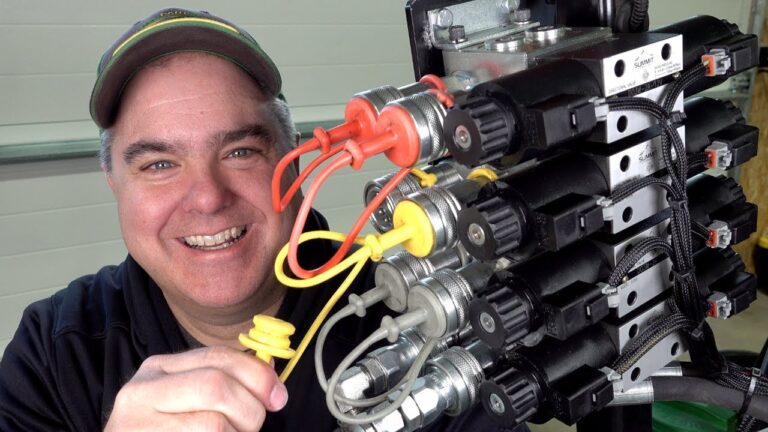
Adding rear hydraulic valves to a subcompact tractor has been a bit of a challenge to date. While some brands offer a dealer installed rear Selectable Control Valve (SCV), these are usually available in limited configurations. For example, on the Deere 1 series, if you choose the rear SCV kit, you cannot have a Power Beyond which is necessary for a backhoe. Additionally, only one rear SCV is available from the dealer.

We have been working with Summit Hydraulics to develop a more general and easily installed rear hydraulic valve kit. Our goal is a set of hydraulic kits which build upon each other to create the ultimate sub-compact tractor hydraulic functionality, front 3rd function combined with rear accessible valves.

Prerequisites

Your tractor must be equipped with a “Power Beyond” kit to connect to the Summit system. Power Beyond is simply an extension of the tractor’s hydraulic loop, allowing new hydraulic circuits to be added.

For a better description of how sub/compact tractor hydraulics work, along with some diagrams, check out this video from Tractor Time with Tim and Ken from BoltOnHooks.com

Basic Hydraulics for Compact Tractors

We chose the Power Beyond approach because many subcompact tractors are already equipped with a backhoe which includes the Power Beyond. All other subcompacts will have the ability to add such a connection. Check with your dealer to get a Power Beyond Kit for your tractor. Please provide feedback in the forum section here if you are having trouble getting appropriate Power Beyond information. If sufficient demand, we will put together some helpful resources and possibly even aftermarket kits.

The Rear Hydraulic Kit

Subcompacts typically do not provide rear hydraulic valves. While most basic attachments do not need hydraulic outlets, we are seeing more and more which DO need some sort of hydraulic control. Stump grinders, box blades with hydraulic scarifiers, pull type box blades, etc.

The base kit provides 2-4 electrically controlled hydraulic valves at the rear of the tractor, allowing control of nearly any attachment with a hydraulic lift cylinder. While this kit is designed to be a perfect fit for the 1025R, it should fit most other subcompacts without modification. The only exception MIGHT be the couplers which connect to the Power Beyond. This kit comes with 1/2″ ISO Ag 5675 couplers. Some machines (New Holland for example), use a different coupler size for their backhoe connection. In this case, you’ll need to get compatible couplers from your dealer.

Before going any further, I suggest that you watch this video from Tractor Time with Tim showing the details of this kit. Seeing the kit installed and functioning on the tractor will help you understand the concepts.

Summit Rear Hydraulic Kit Explained

Other than the Power Beyond, the only other connection you need is electrical.

The kit consists of:

  • manifold block 2-4 valves,
  • couplers,
  • hoses,
  • as of this writing a 2-4 switch box used to control each of the valves.

Work in progress:

  • Place the first two controls on the loader joystick, with scv’s 3 and 4 controlled by toggle switches.

Add On Front 3rd Function Kit

The newest addition to the “Ultimate Hydraulic Kit for Subcompact Tractors” is the front 3rd function extension.

The Add on kit consists of:

  • Hoses and fittings to route one valve under the tractor
  • Bracket to attach front couplers to tractor frame.
  • Hoses and fittings to mount on loader (to extend 3rd function to loader attachment)

If you currently have the 2-4 valve rear scv kit, this add on will provide MOST of what you need to add a front third function. We would suggest that you also add the Joystick Handle so that the 3rd function (and one of the rear functions) can be controlled from the joystick. Depending on the number of functions you purchased, you may want to make one other purchase:

  • 2 Valve: No more purchase necessary. Simply remove the rocker switch, and replace with the Joystick Handle above
  • 3 Valve: Optionally purchase the Single Valve Switch Control, and replace your existing 3 valve switch control with it. This is not required. You can keep your existing 3 valve switch, with only one of the 3 switches active. The other two will be replaced by the Joystick Handle.
  • 4 Valve: Optionally purchase the 2 Valve Switch Control, and replace your existing 4 valve switch control with it. This is not required. You can keep your existing 4 valve switch, with only two of the 4 switches active. The other two will be replaced by the Joystick Handle.

If you do NOT YET have the 2-4 valve rear scv kit, purchase the entire solution including rear scv’s, front 3rd function and joystick handle via this kit.

Be sure to use code TTWT for a 5% discount on any purchase from Summit Hydraulics.

Get One For Yourself!

Order the ultimate hydraulic solution from Summit Hydraulics You can also see the latest availability there. Use code TTWT for a 5% discount!

We’re Not Finished!

We will continue to enhance this solution with more hydraulic features going forward. We are taking a ‘one step at a time’ approach, making sure each feature is well designed and complete.

We’d love to hear your feedback in the forum section, or in the comments section below!

Deere: “Don’t Use Your 1025R, 1023E, or 2025R!!”

34

John Deere announced this week that a brake linkage part could crack and cause a crash hazard. They are suspending all sales, deliveries, and demonstrations of the affected tractors until the issue is corrected.

UPDATE Aug 15, 2024: Recall Has apparently started. However, the list of serial. numbers included we built BEFORE the time window in this marketing bulletin. March 2017- October 2017. Perhaps this recall was issued even BEFORE the July 26, 2024 marketing bulletin? You can find the March-Oct 2017 recalled serial number list here.

Deere Stop Sale 1025R 2025R 1023E Bulletin July 26, 2024
Deere “Stop Sale Notice” for 1025R, 2025R, 1023E ’17-’22

Tractors Affected

1025R, 2025R, and 1023E tractors built between November 1st, 2017 and September 30th, 2022 have the issue. There is no serial number range listed in the bulletin

There is no way to find the built date on the tractor itself. The “calendar year” of the build is shown in the serial number. The 10th digit is the “calendar year”, and the 11th digit is the “model year”.

Here is a mapping of the letter shown in the serial number to the numerical year of production

Deere Serial Number Code to Manufacture Year Mapping

Associated Video

This Tractor Time with Tim video discusses details, as well as some recommendations for you if you own one of these machines.

Video Corrections

The video mentions that the bellcrank is made of cast aluminum. This may be errant. Several commenters suggest that it is made of a zinc alloy commonly called pot metal. TTWT is not an expert in this, so we are not certain.

The Issue

According to the memo, the front bellcrank of the brake linkage could crack and fail, thereby creating a crash hazard.

In laymans terms, your brake pedal could become disconnected from the actual brake. Without a brake, you could, well, CRASH!

This diagram shows the brake linkage. The offending (sometimes breaking) part is circled in red.

Deere 1025R Brake Linkage

The Fix

Unfortunately, Deere has not published a resolution at this time. The memo states that a formal MSPIP (Mandatory Safety Product Improvement Program) is being developed, but it is not ready yet.

What To Do NOW

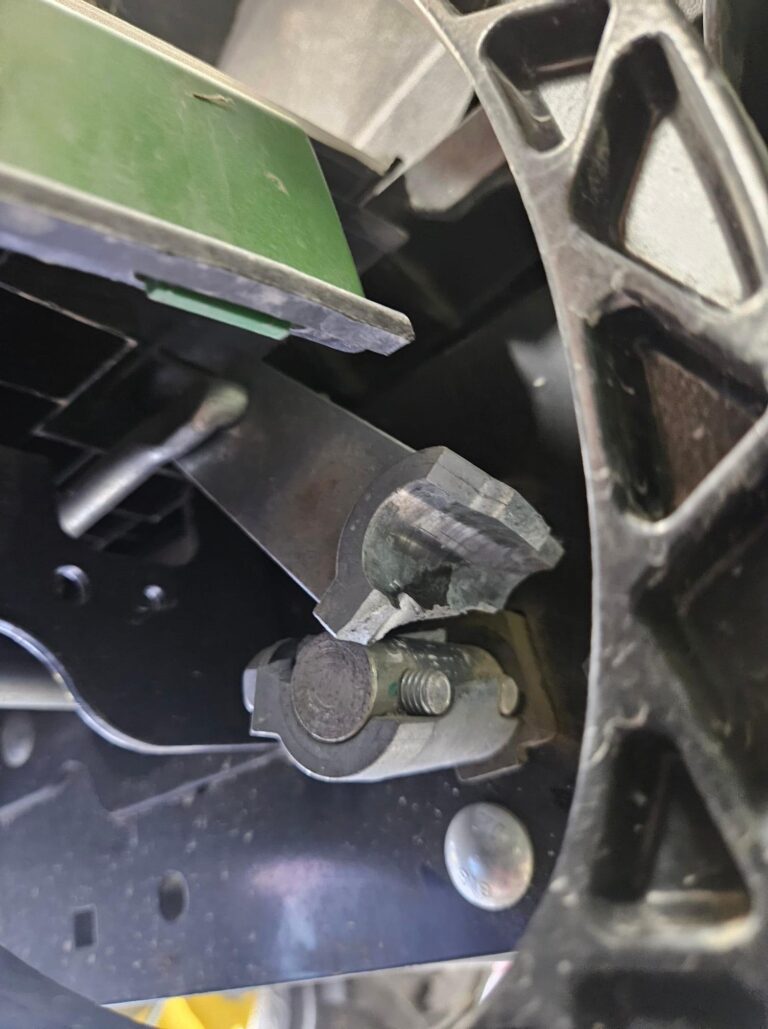
First, check to see if your brake pedal is functional. I would recommend testing this on flat ground. While moving, apply the brake to see if it slows (or stops) the tractor. If not, check the linkage below the right floorboard, just inside the hydrostatic drive pedals. A broken linkage should be easy to spot.

Broken Bellcrank John Deere 1025R
Broken Front Bellcrank – Deere 1025R

If your brake linkage is broken or otherwise non functional, do not operate the tractor. It is simply not worth the risk. If you need to use the tractor soon, order a new front bellcrank. You will likely have to pay for the replacement bellcrank now since the MSPIP has not yet been finalized. We do not yet know if you will be reimbursed, but at least you will be safe. At present, the part is $86. Well worth it for your safety!

You can purchase the bellcrank here.

Updates

We’ll provide updates here as we learn more. Meanwhile the TTWT video above has more information, opinions, recommendations, and photos of broken bellcranks. Check it out.

High End Suspension Seat for Deere 1025R/2025R/1023E

Is your lower back dreading the next tractor project? Perhaps you need an upgraded suspension seat? Subcompact tractors short wheelbase, and small wheels cause a choppy ride. The standard suspension (or no suspension on 1023E) doesn’t help.

Standard 1 Series Suspension

The standard 1025R/2025R includes a suspension mechanism with two springs rated for 118 lbs each, or 236lbs total under the seat. In practice, we find that anyone over 200 lbs will frequently “bottom out”. This jarring experience adds to the already choppy ride.

Inexpensive Option

Bolt On Hooks upgraded (heavier) seat springs compensate for those more “cheeseburger challenged” https://www.boltonhooks.com/john-deere-1-series/ (use code TTWT for a 5% discount), but these springs don’t really do much to reduce the ‘bucking’ feeling generated by the small tires.

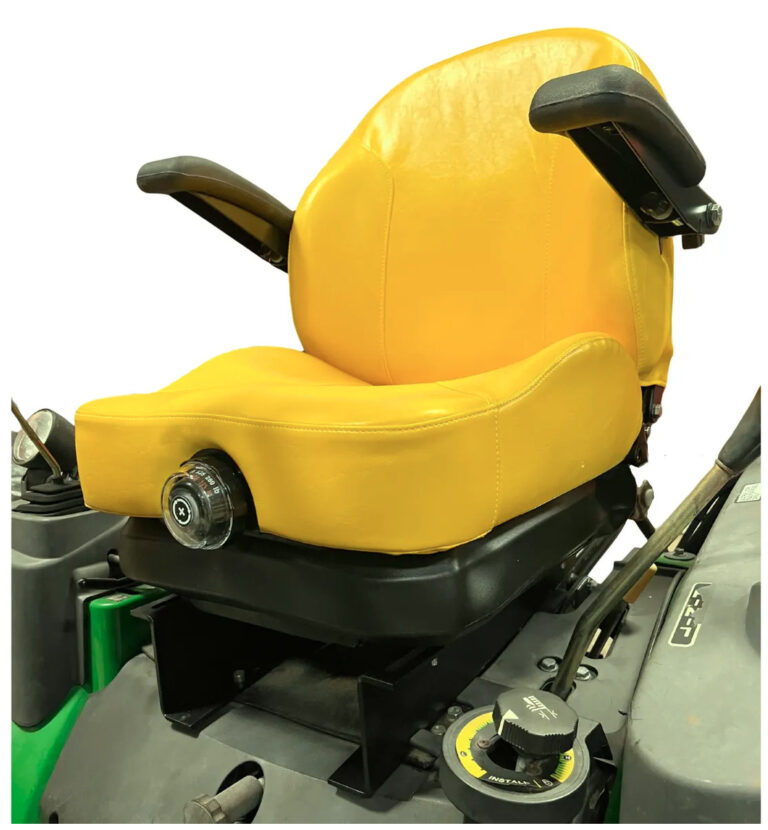
The Solution! TracSeats Pro-Ride!

TracSeats Pro Ride For Deere 1025R Use Code TTWT for 5% off!

Working together with TracSeats.com we are thrilled to be able to provide a MUCH improved ride via the Deere 1 Series High End Suspension Seat. Use code TTWT for any purchase at http://TracSeats.com for a 5% discount, and to support our content and channel. Premium zero turn lawn mowers use this seat. The suspension mechanism is NOT air based, but the manufacturer claims that it works as well as an air seat. We agree.

A large knob on the front provides easy adjustment depending upon the weight of the operator. Christy and I find that the weight readings on the dial are accurate. Meaning, that when we set it to our weight, we find the suspension to be optimal.

We have shown this seat several times in our videos. This episode shows a detailed installation.

This next link should take you to the exact spot where we show the seat in action. This rough riding mowing job shows the TracSeats suspension getting a full workout.

As far as I know, this is the finest seat / suspension option offered for the Deere 1 series tractors. Your back will appreciate this purchase!

Choose the Right Tiller for Your Compact Tractor

150

 One of my favorite attachments for Johnny, our subcompact tractor is our rear roto-tiller. When I first got it, I didn’t expect to use it much. I viewed it as a ‘uni-tasker’, only useful for tilling gardens. This view has proven to be short-sighted. As you’ve likely seen in our videos, we use the tiller for MANY different jobs. It almost always comes through for us.

If you are considering a tractor mounted tiller you may be seeing many different models, wondering which size, style, or brand is the right tiller for you. Hopefully we can help explain and answer some of those questions for you in this article.

You’ll Love Whatever Tiller You Choose

I’ve been reading online tractor forums and talking with tractor owners for several years now. As of yet, I have not heard a single person say that they don’t like their tiller. Not even one! Given this anecdotal information, you might be wasting your time reading this article. Just go get any tiller you see. I am almost certain that you will be happy with it. I’ll refer to this as “Tiller Rule #1”.

Having said that, you wouldn’t have started reading this article if you were an impulse buyer. So, let’s dig into some of the decisions you’ll have to make, and some of the features you might want to consider.

Tiller Width

Optimally, you will choose a tiller which is just a bit wider than the max width of your tractor. This allows you to till out your tire tracks with each pass.

Some older tractors, (think of tractors like the ford 8N, etc) were built very wide, yet they didn’t have much horsepower. For those tractors, you can purchase an ‘offset’ tiller which will allow you to fully cover one of the two tire tracks. The other tire track will not be covered at all. This allows you to till without leaving tire tracks, but only in one direction.

Many of our viewers own subcompact tractors, so let’s consider these specifically. Most of these new sub-compact tractors are very similar in size and horsepower. Just under 25 hp, and just under 4′ in width. For these tractors, Kubota BX, Deere 1-series, Massey GC17xx, etc, get a 4 ft tiller. This will be the perfect width. It will handle the toughest tilling conditions, allow you to get through small gates (54″ or so), and fully cover the tire tracks.

Some folks run 54″ or even 60″ tillers. For example, one of our most loyal subscribers (Levi/mi2tn) has a 60″ tiller for his 1026R. You can get away with a 60″ tiller in an existing garden. However, for sod, or harder or muddy soils, I find the 48″ to sometimes be more than Johnny (our 1025R) wants.

If you have a Deere 2-Series, Kubota B series, use a similar rule, get a tiller just wider than your tractor. Of course, if you have one of the 25hp larger frame tractors (3025E, L2501, etc), you may not have sufficient horsepower to handle a ‘full-tractor-width’ tiller. Again, choose an offset 4 ft. model in this case.

Drive Mechanism

 While all rear tillers are driven by the tractor’s PTO, the power is transferred to the main tiller axle shaft in two different approaches. You will not be able to tell which type of drive is used by looking at the tiller, as this drive is fully encased and enclosed to keep the oil in and dirt out. You will be able to see the enclosure on one end of the tiller.

Chain Drive

One of the drive choices inside the enclosure is a roller chain with sprockets on each shaft. This is the simpler and presumably least expensive of the two options. In theory, the chain drive will be slightly less reliable than the gear drive. However, I’ve never heard of anyone having an issue with their chain drive, and the LandPride rep I spoke with at the Louisville National Farm Machinery show pointed out that if such damage DOES occur, this drive chain is a standard #80 chain, so the mechanism would be straightforward to repair.

Gear Drive

The other drive choice consists of a series of gears which transfer the power from the upper shaft to the tiller axle shaft. While this option seems like it would be more reliable, manufacturers of chain drive tillers are quick to claim that the gear drive version pulls much harder, losing power as it transfers through the gears.

I’m not sure which mechanism I prefer. On the surface, the gear drive would seem more durable, but the simplicity of the chain drive has its advantages too.

Weight

This is one statistic that you should be sure to check. You WILL notice the difference between a heavier tiller and a lighter tiller.

For hard soil, the tiller must have sufficient weight to keep it from bouncing. I would recommend buying the heaviest tiller you can find in almost every instance. The only exceptions would be if the tiller is heavier than the tractor’s 3 point hitch can lift. The LandPride rep says the tiller will only bounce if the tines are worn out. While I’m sure this is largely true, I think it would be hard to prevent a bounce in Patrick’s newly delivered and packed clay. The only thing that MIGHT prevent this would be a reverse-rotation tiller discussed below.

Rotation Direction

Most tillers rotate in the same direction as the tires turn. The top of the tines go forward. However, some tillers have ‘reverse rotation’. Reverse Rotation forces the tiller to dig-in deeper by pulling backwards against the natural direction of travel. Another advantage is that reverse rotating tines do not push the tractor forward. Occasionally, forward rotating tillers can cause the tractor to lunge forward.

My experience with a reverse rotation tiller is limited to the walk-behind variety, as neighbor Bob had one. In perfect conditions, like my garden, the reverse rotation leaves a wonderful seedbed. However, when operating in sod, it would push a large pile of sod up in front of the tiller while operating.

Other viewers have stated that reverse rotating tillers can tend to throw rocks forward (and maybe upward toward the operator). Throwing rocks forward is frustrating because that just keeps them in the path of the tiller so that they will be encountered again.

Overall, I would choose the forward rotating tiller again if I were to buy another one. However, I would not fault others for choosing the reverse rotation, as they certainly have their advantages.

Rotation Speed

This spec may be hard to find on some tillers. The King Kutter brand shows this spec for each model. Surprisingly, there is sometimes a fairly big difference. For example, the King Kutter TG series spins at 210 RPM, while the TG-XB series spins at 250 RPM. All else being equal, I would prefer the faster spinning tiller.

Number of Tines Per Flange


Some tillers have 4 tines per flange, and others have 6 tines per flange. The 6 tine version will have at least a couple of advantages over the 4 tine version. First, it will be heavier. Second, each rotation of the tiller shaft will perform 50% more cutting action.
I would recommend the 6-tine version.

Slip Clutch vs. Shear Bolt

Any PTO powered equipment needs to have some sort of protection in case the implement gets stuck and cannot rotate. Without such protection, something has to give. With a small tractor like mine, often the engine will stall/die. With a larger tractor, something will break. Shaft, gearbox, chain, etc.

Most equipment uses either a shear-bolt or a slip-clutch to provide this protection. A shear-bolt is a bolt holding the PTO shaft to the gearbox shaft. The bolt is sized appropriately so that it will break (shear) before any damage occurs to the equipment. To return to work, one must replace the broken bolt with a new one of the same hardness to continue providing the same level of protection.

A slip-clutch is a set of plates with abrasive material between them. A series of bolts clamp these plates together. Adjusting these bolts allows the plates to ‘slip’ when too strong of a force is applied to the PTO shaft.

Now for a special TTWT thought which likely almost every reader will disagree with. If you are using a 25hp (or smaller) tractor, this protection is not really necessary in my opinion. If our ‘irresistable force’ (tiller tines) encounters and ‘immovable object’ (root or rock stuck between tines and frame), the most likely result is an engine stall from a full-throttle (at least PTO speed) RPM. While this is obviously not optimal for the tractor, it will not tear up the tractor. In my opinion, there is no way a 25 hp tractor can tear up a 40hp (or higher) rated gearbox.   This opinion ONLY applies to these

Ok, with that unpopular opinion stated, I would prefer the slip-clutch approach over the shear-bolt approach. The slip-clutch allows the operator to adjust it as necessary. With a shear-bolt approach, if you encounter a higher stress situation where you shear multiple bolts in normal operation like I did when using the post hole digger, you have only two options. Lots of bolts, or step up to the next hardness of bolt which likely defeats the effectiveness of the shear-bolt protection.

Hitch Compatibility / Flexibility

One very nice enhancement to the 3 Point Hitch system is the “Quick Hitch”. Refer to Quick Hitch Options for more information about quick hitches.

When buying a tiller, I would recommend that you select one which is (or can easily be made to be) quick hitch compatible. The King Kutter XB Tiller which I have is not quick-hitch compatible, but It was not difficult to modify it. Please check out my video on this conversion for more details.

Some tillers have a more advanced feature relating to the hitch. They allow the hitch to be moved to the left or right for an adjustable ‘offset’ feature. For some users this might be a valuable feature.

Brand

There are three major brands that I know of (and several smaller/lesser known brands) which are made in the USA. Land Pride, King Kutter, and Tartar both make reasonable quality tillers.

I believe Tartar makes most of the “County Line” brand tillers sold by Tractor Supply, but this can change (and has changed) over the years.

Again, let’s talk specifically about the sub-compact tractor scenario. For the King Kutter brand, the King Kutter II models are offset when in the 4′ width.
The offset may make it show just a bit of tire track on one side of the 47″ wide tractor. So, I don’t think it is the best choice for a sub-compact tractor.

The King Kutter XB (like mine) is not quick hitch compatible, and is not quite as heavy as the King Kutter II, but it spins faster, and it is centered.

Take a look at Tractor Basics for a cost effective yet high quality American made tiller. They have two models in their lineup. An entry level 4 tine per flange chain drive model which comes only in a 4′ width, and a full featured 6 tine per flange, gear drive model which comes in 4′ and 5′ widths. Of course, I’m a bit of a tiller snob, as you’ve noticed already, so I prefer the full featured model, but either way, you will find this tiller cost effective, and tough enough for anything you can throw at it. Oh, and I almost forgot to mention the TTWT discount! Apply code TTWT at checkout for a nice 10% discount!

On the topic of reverse rotation, Land Pride appears to be the leader in this approach.

Several viewers end up buying their tiller with their tractor “so they can get it financed together”. Before you make that choice, please review the list of differentiators above. Then, ask yourself if it is worth 50% to 100% more to get the financing. In general, we don’t recommend this approach.

Summary

There are lots of choices in the tiller world. Hopefully this article has helped to identify some of the differences between different models. If you are still struggling to determine which tiller is right for you, just remember “Tiller Rule #1”. EVERYONE seems to be thrilled with their tiller. No matter WHAT brand.

Just get one…and start enjoying it!

Protect Your Tractor Radiator: A Guide to Installing Brush Guards

29

An area of your tractor that can be vulnerable to costly damages is its front end, especially the radiator. A minimal investment into brush guards can prevent expensive repairs to your coolant system and headlights, while preventing dents and scratches to your tractor’s grill and front clip. Brush guards can be installed with relative ease and keep your tractor in good condition.

The Importance of Tractor Brush Guards

Brush guards are a critical addition to your tractor. They provide both the machine and the operator protection from rough terrain or debris you may encounter. Protect your compact tractor’s radiator, coolant system, and headlights and prevent damage to the grill and front clip with a brush guard.

Tractor Time with Tim has found a great solution to protect your tractor by way of the creative ingenuity of the team at 5 Eleven DesignZ from southern Michigan. Order now with the promo code TTWT to get 5% off! 5 Eleven DesignZ produce high quality tractor accessories via their CNC laser cut American steel and powder coating process. Their accessories are designed for multiple series of John Deer, Kubota, and Kioti tractors.

Promo code for tractor products

Step-by-Step Tractor Brush Guard Installation Instructions

Installation of your new brush guard from 5 Eleven DesignZ is relatively easy to install. The average installation takes approximately 30 minutes. Hardware for mounting the brush guard is included.

John Deere Brush Guard Installation

The 5 Eleven DesignZ John Deere kit includes 4- ¼”x1” stainless steel button head screws, washers, and nylon lock nuts. For completing the installation on your John Deere it will be necessary to have the follow tools on hand:

  • Spring clamps
  • Permanent marker
  • Center punch
  • Hammer
  • 1/8” drill bit
  • 1/4” drill bit
  • Drill
  • 7/16” wrench or 7/16” socket wrench
  • 5/32” allen wrench
  1. Dry fit the 5 Eleven guard.
  2. Use spring clamps to hold the unit in place.
  3. Mark each side through the oval shaped holes with a permanent marker.
  4. Use center punch each on marks.
  5. Drill pilot hole followed by the ¼” bit
  6. Use hardware to fasten the brush guard to the frame and slightly snug the screws.
  7. Pivot brush guard and use clamps to hold in place.
  8. Repeat steps 3 through 7 for the lower mounting holes.

Kubota LX3310 Brush Guard Installation

The 5 Eleven DesignZ Kubota installation hardware includes 2- 3/8”x1” stainless steel button head screws, washers, and nylon lock nuts. The Kubota requires a slightly different installation than the John Deere and requires a few other tools for mounting your new brush guard. You will need:

  • Wrenches/sockets to remove for lower pivot bolt hardware
  • Spring clamps
  • Permanent marker
  • Center punch
  • Hammer
  • 1/8” and 3/8” drill bits
  • Drill
  • 9/16” wrench or socket
  • 7/32” Allen wrench
  1. Remove each of the nuts and washers from the large pivot bolts at the bottom on each side of the factory brush guard.
  2. Place the 5 Eleven guard into the factory brush guard with the 5 Eleven emblem facing forward.
  3. Line up mounting flanges and push large pivot bolts back through the frame and new mounting flange.
  4. Realign the brush guard
  5. Mark each oval hole in mounting flanges with permanent marker.
  6. Use a center punch on your marks.
  7. Drill pilot hole followed by the 3/8” bit.
  8. Return the 5 Eleven brush guard back into position so mounting flanges are aligned.
  9. Use hardware to fasten the brush guard to the frame and slightly snug the screws.
  10. Tighten the lower frame bolts.

Fixing Brush Guard for Tractor Issues

One person should be able to install a tractor brush guard on their own, but a second pair of hands may be helpful when lining up and marking the tabs. Your brush guard can pose a few additional challenges to troubleshoot when installing.

Kubota owners: when mounting your brush guard be sure it does not rub on any of the existing parts of your tractor. It may be helpful to keep the brush guard a bit more forward to clear your grill.

As for the John Deere installation: an extra set of hands may be helpful as you line up your brush guard to mark your pilot holes. Another way to circumvent this issue would be to remove the factory brush guard, and place the entire unit on your workbench or vise to line up the tabs for drilling. Adding front end weights may require alteration as the factory weight holding bar is inaccessible with the brush guard installed.

Don’t forget that when you order your brush guards from 5 Eleven DesignZ, use the promo code TTWT for 5% off!

Conclusion:

The brush guards from 5 Eleven DesignZ are easy to install, add excellent protection, and simply just look good. The next time you hook in your grapple and complete some aggressive operating, a brush guard install could save you significant repairs and costly damage if debris were to make into your front end, especially the vulnerable radiator.

We look forward to providing you with additional resources for your compact tractors. Please don’t forget to subscribe to our YouTube channel! As a final reminder, use the code TTWT at checkout when ordering your 5 Eleven DesignZ brush grills for John Deere or Kubota tractors.

Disclosure: Please be aware that the promo codes and deals mentioned in this article may no longer be active or valid at the time of your reading. Companies often update their promotions and discounts, so we recommend visiting the respective websites for the most up-to-date information on any offers or discounts mentioned in this article.

A Guide to Tractor Enthusiast Gift Ideas

34

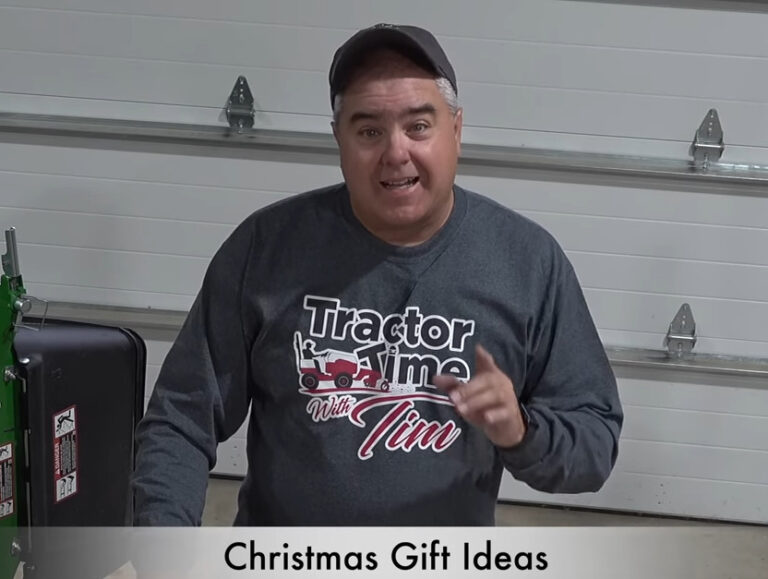
This video was created for Christmas 2022 but you can still find great ideas for unique tractor gifts!

Whether you’re shopping for yourself or looking for the perfect gift for a friend or loved one, exploring exciting and innovative gift ideas for tractor enthusiasts is always a great idea. One of the most delightful sources of inspiration for tractor lovers is the annual Christmas gift ideas showcase on “Tractor Time with Tim.” From new merchandise to practical tools, this episode never fails to bring smiles to tractor enthusiasts everywhere.

Introducing New Tractor Merchandise with a Twist

“Tractor Time with Tim” has teamed up with a small, family-run merchandise provider based in Wyoming. The new merchandise line boasts improved quality and fresh designs that are sure to delight fans. One unique feature is the option for customization. Instead of being limited to the standard “Tractor Time with Tim” branding, customers can now choose to personalize their items with names like “Tractor Time with Grandpa” or “Tractor Time with Christy.” This playful twist allows fans to have fun with their own family and add a touch of personality to their gear.

Visit our site for customized merch!

Lube Shuttle: A Game-Changer in Grease Management

One of the standout products for tractors is the , a specialized grease gun that offers a new level of convenience. Its unique design allows for easy tube replacement and customization. You can watch our TTWT YouTube video for more information.

An exclusive offer through Tractor Time with Tim includes a free case of high-quality mos2 grease with the purchase of the electric Lube Shuttle. This special offer is accessible through a link provided in the episode description, making it an enticing opportunity for viewers.

Use code TTWTMOS2 to get this free case of grease with purchase of the electric Lube Shuttle grease gun. Use code TTWT for 5% off all other Lube Shuttle purchases.

Snow Removal Enhancement Gift Idea

For those seeking improved efficiency in snow removal, we discuss the latest version of Edge Tamers in our video. The new cast version offers more strength and cost-effectiveness than the others which were welded. It’s a great addition to your tractor for snow removal.

Use promo code TTWT for a 5% discount of Edge Tamers!

ISOtunes Noise Isolating Bluetooth Hearing Protection

Coupon code TTWT provides a 10% off coupon code for all ISOtunes products. ISOtunes offers both “in the ear” and “over the ear” isolation from loud noises such as tractor engines and attachments.

My favorites are the Xtra 2.0, and the Free 1.0. However, the code applies to ALL models. Check them out!

120R Loader Dolly from Deck Dolly

From the folks at Deck Dolly, introducing this quite unique item: the Loader Dolly. You put these two under the front of your 120R non-self-leveling loader, and then you put this under the crossbar, and that way when you unhook the loader, you can slide it around easily. This is an impressive, simple kit to make your loader move around very nicely.

Again, use code TTWT for 5% off!

Promo code for tractor products

Mudd’s Customs Deck Stands

We recommend the deck stands from Mudd’s Customs, which make storing your mower easier. These stands are versatile, and I recommend that the deck stands be used in combination with the Load and Go system.

You can get the deck stands with a 5% discount using the code TTWT at Mudd’s Customs.

The Load and Go are available at GreenPartStore.com with FREE ECONOMY SHIPPING using the coupon code TTWT.

Here are links to the appropriate Load and Go for your particular tractor/deck:

1023E/1025R/1026R 60D All Model Years
2025R 2017+ 60D
2025R 60D must also order this!
1025R 54D 2020+
2025R 54D 2017+

Agristore USA Hydraulic Top Link

A hydraulic top link makes for an excellent gift idea for tractor enthusiasts. While I’ve previously discussed a similar Hydraulic Top Link product on my YouTube channel, I had reservations due to a few issues, with the primary concern being the absence of a check valve. However, the hydraulic top link I recommend from Agristore USA addresses this issue.

This Italian-made product features a check valve, which ensures there’s no gradual leakage over time.

It’s available at Agristore USA and can be further discounted with the code “TTWT.

Loader Payload Estimate with HydrosPlus Inline Oil Pressure Gauge

HydrosPlus, the company behind this next innovative product, places a high value on its early customers and continually enhances its offerings, fostering a unique and rewarding partnership.

For the geek tractor operators, I’d like to introduce a fascinating product: an inline oil pressure gauge designed for your loader. Using this gauge, you can get a rough estimate of the weight you are carrying in your loader bucket. What sets this product apart is its evolving functionality. While it currently provides oil pressure data, it’s undergoing development to offer even more precise weight measurements. Early adopters of this product will benefit from ongoing upgrades as it evolves.

Order from HydrosPlus and use the code TTWT for 5% off.

Subscribe for Future Tractor Discounts

These are my favorite episodes to put together, so please consider subscribing to learn what new tractor offers we have for you during the upcoming holiday season! Whether it’s personalized merchandise, cutting-edge tools, or accessories that enhance tractor functionality, this episode showcases a diverse array of thoughtful gifts that are sure to spread joy to tractor enthusiasts around the world.

My product recommendations encompass a variety of tractor accessories and tools that can significantly enhance the efficiency and enjoyment of your tractor. For additional discount opportunities, please read the description in the YouTube video!

Disclosure: Please be aware that the promo codes and deals mentioned in this article may no longer be active or valid at the time of your reading. Companies often update their promotions and discounts, so we recommend visiting the respective websites for the most up-to-date information on any offers or discounts mentioned in this article.

Fixing the Hood Release on John Deere Tractors

25

Watch TTWT’s informational tractor video to see how to fix the John Deere hood release issue.

Tractor Time with Tim viewers know our love for John Deere tractors.  But we readily admit that they are not perfect.  One pesky component that we will address and correct is the hood release mechanism on several series of John Deere compact tractors. The factory hood release requires operators to jam an object into the hood latch to release the mechanism to access the tractor’s power plant which has proven to be a frustrating process for operators, owners, and mechanics.


Understanding the Frustrating John Deere Design

Before we begin to point fingers at John Deere, let’s take a deep dive into why such a frustrating design exists. The rationale for the design and application of such a problematic hood release mechanism originates not here with the engineers and designers of John Deere, but the European Union.

Due to some European safety requirements, accessibility to the tractor’s engine components can only be accessed through the use of a key or tool to release the latch. For sake of consistency, John Deere and several other tractor manufacturers have universally installed this particular latch on all domestic and export models.


The Simple Tractor Hood Release Fix for John Deeres

TTWT has discovered a simple fix to the hood release issue for John Deere 1, 2, 3 and 4 Series Compact Tractors. Say goodbye to blindly jamming a screwdriver into the latch mechanism to release the hood thanks to a nifty product from 3D Fusion Labs.

The team at 3D Fusion Labs have developed a brilliant solution that is easy to replace and enables you to add some customization to your John Deere by offering an array of colors. 3D printed on rugged outdoor plastic, the replacement kit includes the replacement mount, button, and nut.

If you use the promo code TTWT at checkout to get a discount on your 3D Fusion Labs order. You can also use the same promotion code for free shipping of John Deere Parts

How To Install Hood Release Replacement

Installation of the 3D Fusion Labs hood release replacement is a simple process by following these easy steps:

  1. Release the factory hood latch (for the last time!)
  2. Remove the existing nut on the factory latch with a 7/16” wrench.
  3. Remove the factory latch assembly.
  4. Install new button assembly, be sure to align the rod through the hole in the unit.
  5. Secure unit by reinstalling nut and tightening it down snuggly.
  6. Press your new 3D Fusion Labs button to release the hood.

Overall, generally the installation process can be completed in 30 seconds and opening your hood can be done in 3 seconds.

Benefits of John Deere Hood Release Installation

The key benefit of upgrading your hood latch mechanism from 3D Fusion Labs is alleviating the frustration of poking and prodding the factory hood release in hopes to access your tractor’s mechanicals. Installation is a breeze and the maintenance of your tractor will be less frustrating and time-consuming. 3D Fusion Labs hardware is also ethically pleasing and offers your John Deere compact tractor a custom look.

Additional John Deere Parts Support

The team at 3D Fusion Labs is a great source for custom tractor parts and upgrades. They now manufacture John Deere 4WD kick Pedals, throttle and PTO paddles, floor plugs, and front end loader grease caps. The products from 3D Fusion Labs are designed and built with quality to provide the best experiences operating your compact tractor.

TTWT Tractor Discounts

Don’t forget to use the TTWT promo code when purchasing from the 3D Fusion Labs website for your 5% discount. You can also support Tractor Time with Tim by using the TTWT promo code at these tractor product sites.

5% Discounts: Tractor Product and Supplies

10% Discounts: Tractor Product and Supplies

AgristoreUSA (hydraulic top links)ISOtunes Bluetooth Hearing Protection
Baumalight Stump GrinderAriat Clothing
Deck DollyTim’s Favorites
Discount HydraulicsLimbsaw
Heavy HitchMacnaught
Hood GuardsCanamek Laser / GPS Grading
Hydrosplus

TTWT Supporters

Ken’s Bolt on HooksAHW John Deere Dealership
Lube ShuttleArtillian
Mudd’s CustomRhino Ag
Precision GrappleIAEquip
PTO Link21st Century Equipment
Summit Hydraulics

TTWT Tractor Resources

Follow our simple tractor hood release installation tutorial and save yourself the headache and frustration of accessing your John Deere’s mechanicals. 3D Fusion Labs’ solution will make maintaining your compact tractor a snap and keep you where you should be: behind the wheel.

Don’t forget to subscribe to our YouTube for fresh tractor content!

Until next time, happy operating!

Disclosure: Please be aware that the promo codes and deals mentioned in this article may no longer be active or valid at the time of your reading. Companies often update their promotions and discounts, so we recommend visiting the respective websites for the most up-to-date information on any offers or discounts mentioned in this article.

Solving a Hidden Issue: Relieving Front Axle Pressure on Tractors

32

Tractors are undoubtedly vital workhorses on farms and properties, enabling a wide range of tasks from plowing fields to transporting heavy loads. However, beneath their rugged exteriors, there’s a hidden problem that many tractor owners might not even know they have – pressure buildup in the front axle.

Watch our informational YouTube video where Tractor Time With Tim discusses this lesser-known issue, its potential implications, and introduces a unique solution that could save you from costly repairs.

Tractor Oil Leakage Issue

The issue of pressure buildup or vacuum formation within tractor front axles is a prevalent concern caused by the demanding nature of heavy-duty use. Although not all tractors exhibit this problem, it has the potential to affect the longevity and overall performance of almost any tractor that experiences it. This challenge arises due to the consistent strain endured by the front axle during rigorous operations. Overloading the front axle, causing oil to contract and create a vacuum, or inducing expansion that generates pressure can all contribute to the stress on seals and gaskets positioned around the front wheel area. If this pressure or vacuum is left unattended, it can gradually weaken the seals, leading to oil leakage and potential performance degradation over time.

The Tractor Ventilation Solution

To combat this pressure and vacuum dilemma, we introduce a clever solution in the form of a specially designed vented dipstick. Created by Otis Innovations, this replacement dipstick is engineered to mitigate pressure and vacuum buildup within the front axle. The dipstick features a small hole and is connected to a rubber hose that vents excess air pressure or allows air to enter to equalize pressure, preventing stress on the seals.

Tractor Time With Tim viewers get a special 5% discount on Otis Innovations Vented Dipstick for John Deere 1, 2 or 3 Series if they use the promo code TTWT.

Promo code for tractor products

How To Install a Vented Dipstick for Tractors

Every tractor is different, but the majority of them should have the same general instructions for how to install a vented dipstick. Installing the vented dipstick involves a few simple steps:

  1. Remove the existing dipstick.
  2. Attach the rubber hose to the new vented dipstick.
  3. Secure the hose with adhesive holders and zip ties.
  4. Route the hose along the tractor’s structure to avoid interference.
  5. Trim the hose to an appropriate length.

This innovative solution not only addresses the pressure and vacuum issue but also prevents dirt and debris from entering the axle system. While the vented dipstick may seem like a small change, it has the potential to extend the lifespan of your tractor’s seals and gaskets, reducing the likelihood of oil leaks and costly repairs.

A Practical Solution for Tractor Owners

Pressure buildup and vacuum formation in the front axle of tractors might not be on every owner’s radar, but it’s a concern that can impact the longevity and performance of these hardworking machines. By addressing this issue with the vented dipstick solution, tractor owners can potentially prevent oil leaks and extend the lifespan of their equipment.
As with any modification or solution, it’s essential to conduct proper research, consider your specific tractor model, and assess your individual needs. While the vented dipstick solution might not be suitable for every tractor owner, it’s undoubtedly a noteworthy innovation in the world of tractor maintenance and performance enhancement.

TTWT Tractor User Resources

Whether you’re an avid tractor enthusiast or a casual user, staying informed about potential issues and innovative solutions can help you make the most of your equipment investment and ensure that your tractors continue to operate efficiently for years to come.

Tractor Time With Tim is always creating new content to help tractor uses learn more about their issues and find solutions. You can support TTWT by subscribing to our YouTube, following us on Facebook, ordering our merchandise, and shopping our favorite products. Remember, if you are experiencing this tractor vent issue, you can order a Vented Dipstick for John Deere 1, 2 or 3 Series here: https://www.otisinnovation.com/ – Be sure to use code TTWT for 5% Discount!