Wednesday, March 25, 2026
Home Blog Page 3

Which Tractor Should He Buy? – Don

Don wrote a very descriptive note listing his needs, wants and limitations. Here it is:

I am looking at a sub-compact tractor and grapple, but I have 10 heavily wooded acres to clean up after Hurricane Michael (lots of large oaks and pines down and in need of removal. Normal years limb falls and downed trees are always in need of removal. I am a wood turner and sculptor and like to have medium sized pieces of larger logs to deal with (8 to10′ x 20″dia ). The land has many ruts and hills and eventually ends in a live stream, so I think I am going to have to step up to a more $$$ compact tractor to get the ground clearance and stability necessary. I am looking for a JD 3032 or 3038 used or new if the $$$ work out (not sure the 3025 would have the power needed)… any suggestions ? I am pretty much sold on JD because we have a local dealer with a good rep for service here. Lots of other dealers within a 50 mi. radius, but I don’t have the inclination to make a 100 mile round trip for service and parts etc.

Don

First, Don has done an outstanding job of thinking through his needs. This is a very important step. I would recommend that other readers would take time to make a bullet list of potential uses of their tractor, as well as thoughts about the local dealers, budget, etc.

Don has already settled on John Deere. He has stated that if necessary, he can afford to spend a bit more to get a larger tractor. These two points give us some flexibility.

Ruts, hills, streams, does indeed indicate the need to step up from a sub-compact. So, the 1025r does not look like a good fit. I would also say that the 2025r does not fit very well either. It is quite narrow, and with this type of terrain, I do not believe it would be suitable for Don.

So, let’s step up to the next size that Don is considering. The ‘3e’ series. Each of these machines uses the same loader, so even though there is a significant difference in horsepower, they will all perform similarly with the front end loader (FEL). I would encourage Don (and other readers) needing a bit more loader ‘umph’ to take a close look at the specs of the 300e loader as compared to the 120r and 220r loaders.

Lift those Logs!

120r on 1025r120r on 2025r220r300e
Lift Capacity to Max Height (500mm in front of pin)520lb553lb803lb845lb
Boom Break out force (500mm in front of pivot)1320lbf1335lbf1360lbf1204lbf
Bucket rollback force at ground level1807lbf1659lbf2138lbf1422lbf
Max lift height72 inches72 inches85 inches84 inches

Notice that in each category other than ‘max lift capacity at full height’, the 220r loader on the 2032r and 2038r is ‘stronger’ than the 300e loader (on any 3e tractor). One would think that the ‘3’ series would be more capable than the ‘2’ series. However, in this case, the 2r appears to be the more capable machine.

I got to use a 3032e for several hours early this spring. Now, I have had a 2038r for several months. I can confidently say that the 2038r is significantly more tractor than the 3032e. I do not believe my opinion is due to horsepower. I’m sure a 2032r would impress me just as much.

Just for completeness, we should consider the 3033r. The 320r loader capacity far exceeds those listed above. This tractor will feel much more powerful and capable than the 2r (or 3e). Further, it is about the same physical size (length and width) as the 2032r/2038r, so it should be just as maneuverable.

The 3r tractors have the option of a wonderfully designed factory cab. This cab is cool in the summer, warm in the winter, and quiet all year! However, there are 3 potential negatives.

  1. It is tall, and will interfere with the brush in some scenarios.
  2. Makes the tractor more tipsy on hills,
  3. Expensive!

The 3r tractors are not quite as refined as the (much newer) large frame 2r series. This makes sense as the 3r hasn’t changed much for many years. It is very similar to the 3320-3720 from 10-15 years ago. The levers are not as comfortable to control (ergonomics improved on the new 2r), and the engine is much louder than the large frame 2r.

Don’t misunderstand me, Deere did an amazing job on the 3r design. It has obviously stood the test of time, since it hasn’t seen a major update in over 10 years.

Mandatory Attachments/Modifications

No matter which tractor you choose, to lift those heavy logs and transport on uneven terrain, you MUST have lots of rear ballast. I would recommend a ballast box, or Heavy Hitch with a complete set of weights, matching the recommendations in your loader manual. This often seems like an extreme amount of ballast but it really IS required.

Additionally, I would recommend getting RimGuard tire fluid added to the rear tires for additional stability.

Summary

Quite frankly, I’m not a fan of the Deere 3e series. I like having the option of a mid mount mower, removable loader, auto-throttle, more comfortable seat, and more powerful loader.

Therefore, I would narrow my choices to the large frame 2r (2032r/2038r) or 3r (3033r/3039r/3046r) tractors.

I suspect the 2032r / 2038r would lift the logs you are describing. However, you may not have much capacity to spare. This tractor is the most refined tractor in the Deere compact tractor lineup.

If you are worried about being able to comfortably lift those largest ’rounds’, I would step on up to the 3033r (or 3039r). This tractor packs an enormous punch in a small package.

I believe you would be happy with either of these tractors.

Your Turn!

For the rest of our readers, what do YOU think? Which tractor would YOU recommend for Don?
Hydraulic Thumb for Deere 260B, 270B, and 370B backhoes

22

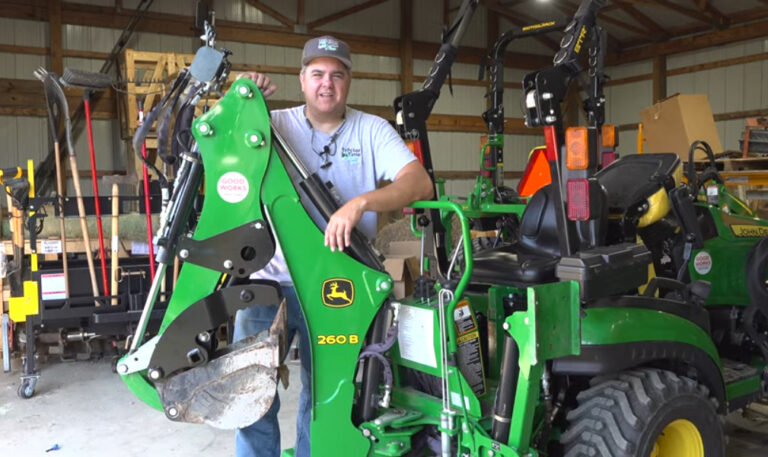
Deere has introduced a Hydraulic Thumb for its small compact/subcompact tractor backhoes. While several folks have fabricated their own hydraulic thumbs, to my knowledge, this is the first complete kit available for subcompact and small compact backhoes.

Here is a link to the Hydraulic Thumb Kit and in case you are interested, here is a link to the somewhat similar Manual Thumb Kit

The same kit works on 3 backhoe models:

  • 260B for 1025R and 2025R 2018 model year and later
  • 270B for 2032R and 2038R 2017 model year and later
  • 370B for 3025E, 3032E, and 3038E 2018 model year and later

The installation varies slightly within the 3 models, but it is very similar.

Before we get into the details, I would suggest watching this video where I install and test the hydraulic thumb.

<video>

Installation

Installation of the thumb is relatively easy. No complex tools are needed, nor do you need 7 hands or a college degree to figure it out. Just normal tools like end wrenches, screwdrivers, etc.

Step 1 – Attach the Thumb

There is no cutting, welding, boring, etc required for the installation. This thumb connects to the backhoe boom via the two ‘protruding’ fins near the ‘elbow’ of the backhoe arm. On the other end, it connects to the main bucket pivot pin. In fact, a longer pivot pin is provided as part of the kit to handle the additional width of the thumb.

In this step, you’ll attach the bottom of the thumb to the main pivot pin. I lowered the backhoe bucket to the ground, but made sure there was no pressure on it. This allowed me to remove the old pin, and replace with the thumb and new pin without moving the bucket at all. This saved a significant amount of lifting.

After putting the appropriate fittings on the cylinder, you will mount it to the top end of the boom arm using the the included brackets. These brackets ‘clamp’ around the boom providing additional strength and stability.

During this step, make sure you position the cylinder fittings correctly (unlike me in the video). Otherwise, you will be repeating this step!

Avoid connecting the bottom (rod end) of the cylinder to the thumb at this point. It was tempting for me, as I wanted to see how the finished product would look. However, it is much easier to connect the hoses if the bottom of the cylinder swings freely.

Step 2 – Attach Top Bracket/Diverter

The manual diverter is mounted on the outside of the ‘elbow’ of the boom, right at the top. During this step you will assemble the diverter fittings, and attach it to the boom. This step all went as planned for me. I did not encounter any issues.

Step 3 – Hydraulic Hose Installation

This is definitely the most complex step. Having said that, it is still not difficult. Just be patient.

First, the kit includes 4 hoses. 3 of which are identical, except for length. There is no way to identify which of those 3 hoses belongs in a given location. Please refer to my video for descriptions of this. I guessed correctly, so I would encourage you to follow the same approach.

The second similar challenge is with the T fittings, and ‘union’ fittings provided. At first, it seems difficult to understand which one is to be used in which step. The provided instructions are not very helpful, as they do not include anything to distinguish these parts. Having said that, once I started putting these fittings on, I found that only certain ones fit. So, by simple trial and error, I was able to quickly figure out which fittings to use in each location.

If a Deere representative is reading this, I would encourage you to review this documentation. Show pictures, or otherwise help the DIY installer understand which parts to use on a given step. There is a cross-reference chart, but it does not show any photos, only part numbers. The part numbers are not helpful to consumers.

While these issues were momentarily frustrating, I worked through them quickly, and our video should help you to gain an even quicker understanding. So, please don’t use these paragraphs as an excuse to pay someone else for this task! You can do it!!!

Be sure to use two wrenches, one on each side of the connection when tightening the hydraulic connectors. Be sure to check for leaks (as I showed in the video).

At this point, you should be ready to exercise your thumb!!

Operation

This thumb operates slightly differently than a thumb on a larger backhoe or excavator. While it is hydraulic, it does not have fully independent control. It is connected to the dump/curl bucket circuit. As you curl the bucket, the thumb extends. As you dump the bucket (actually after the bucket is all the way dumped), the thumb retracts.

The manual diverter valve allows you to disable the thumb entirely, or use it as described above. There is no separate ‘button’ or ‘lever’ to control the thumb.

I have used this thumb on one project, to pull one large ‘Red Tip’ bush stump. It worked well for me in this application. However, I have not had sufficient experience with it yet to provide a more informed review.

Summary

The first hydraulic thumb kit for a sub-compact (and small compact) backhoe attachment. Wow. Just a few years ago, folks were making fun of these little backhoes, saying they were useless. Apparently the secret is out! These little tractors and backhoes can accomplish tasks much larger than anyone ever dreamed.

I know this kit is expensive. However, it may be exactly what you need to improve your backhoe efficiency!

New Deere Equipment! Thanks AHW!

23

We are excited to welcome AHW LLC to the Tractor Time with Tim family!

We get many questions about John Deere equipment for which we have no access or experience. Questions like:

  • Which tractor should I buy?
  • Would the 2-Series be better for that job?
  • Why don’t you use a larger tractor?
  • Have you tried the 4-in-1 bucket?

Our new partnership with AHW will allow us to show you real-world productivity with a larger selection of Deere equipment.

The Equipment

Gator 835M HVAC – “Allie”

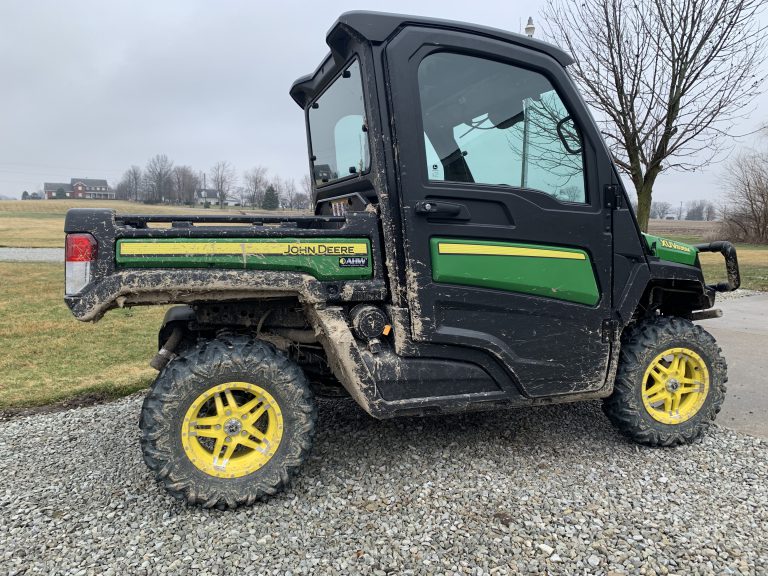
With our larger property, we are excited to have access to a Gator UTV. We picked up the 835M HVAC, aptly named “Allie” a few weeks ago. You’ve likely seen cameo appearances in recent videos.

Christy has already claimed Allie as her own. She uses it to take out the trash, run to the mailbox, etc.

I have been using it to save trips between our garage and our shed, as we have tools and equipment scattered in each. We still aren’t organized since our move, so each project requires searching for the proper tools and supplies!

Deere 835M HVAC
“Allie” Needs a Bath

Allie has a “power dump” feature which Christy absolutely loves. She throws the trash bags in the back, drives to the road, and dumps them without ever leaving the cab. No more complaints about the cold weather!

In addition to the ‘work’ items listed above, we have enjoyed tooling around the yard and neighborhood on Allie. As this photo shows, she has already seen some mud!

2038R TLB “Johnny 2”

We hear folks singing the virtues of the large frame 2R on all of the online forums. While we had been thinking of getting a 3R, AHW convinced us to try the 2038R for this year.

From our investigation on dealer’s lots, we see that the ergonomics of the large 2R’s are far superior to the 3R. For example, arm rests are not offered on the open station 3R, and the joystick is not quite as handy.

We will have much more to share about this tractor throughout the season. We are INCREDIBLY excited to add it to our fleet.

Player to be Named Later!

We have to keep SOME suspense, right? Let me just say that you WILL be surprised with this new family member!

4-in-1 Bucket (AY11F)

We get lots of questions about 4-in-1 buckets. AHW has provided the 53″ model which will fit Johnny I and Johnny 2. We will have the Artillian 3rd function on each machine, so we will use/evaluate the 4-in-1 on both!

The Deal

We are renting the equipment from AHW LLC for 12 months. While we are paying a significant portion of the rental cost, AHW is handling the biggest part of it. This allows us to have more Deere equipment on our property than we could afford on our own.

At the end of the rental period, we have the option to purchase this equipment or return it to AHW.

Summary

We are convinced that this additional equipment will help us provide more informed and entertaining videos. Of course, it will take some time for us to obtain the necessary attachments for the new machines, but over time, we expect to be able to provide detailed information and detailed answers to the questions above.

We are thankful to AHW for setting up this partnership. We think this is only the beginning of a long relationship.

Skid Steer Quick Attach Vs. JDQA

33

Quite often when we see non-Deere dealers discussing the advantages of their (sub)compact tractors, they will mention the Skid Steer Quick Attach loader connection. Usually, they will sneer at “the other manufacturer” who uses a “proprietary” connector, obviously insinuating that no one in their right mind would prefer THAT connector! In this article, we will dig into this topic to see if this “proprietary” connector has any merits, or if it deserves the scorn shown during these conversations.

I had the opportunity recently to meet Neil Messick from Messick’s Farm Equipment. Christy and I thoroughly enjoyed our visit with Neil. He is incredibly knowledgeable in the compact tractor space, very friendly and easy going. After just a few minutes I knew that he and I would get along fine. This is one of my favorite parts of the compact tractor universe. We meet quality people everywhere we go.

Anyway, Neil recently published a video titled “The downside to a skid steer quick coupler”. I’ll include a link to this video here:

The downside to a skid steer quick coupler – Neil Messick

In this video, Neil does a fabulous job of explaining the advantages and disadvantages of the Skid Steer Quick Attach (SSQA). I’ll briefly summarize

SSQA Advantages (vs. pin on bucket)

  • Easily change from one front end loader attachment to another
  • Extend the tractor’s utility and functionality by providing access to a “world of unique attachments” such as snow-pushers, grapples, pallet forks, loader mount blades, etc.

SSQA Disadvantages (vs. pin on bucket)

  • Weight (~86 lbs heavier than pin on) Reduces BX lift capacity from 509lbs to 423lbs (consuming 15-20% of the loader capacity!)
  • Reduced break-out force due to the bucket being extended outward from the hinge.
  • Cost ($500 cost adder on BX). …Tim added this one. Neil didn’t mention it.

Neil concluded that the SSQA was useful for most (95%) of his compact tractor customers, but that in some instances, namely the BX, the SSQA’s additional functionality might not be worth the tradeoff in loader lift capacity.

As I was watching, I realized that I agreed with all of the facts presented in this video. However, I was reaching an entirely different conclusion.

Neil, You’ve made my case!

Early in this video, Neil mentioned condescendingly that “you should laugh at all the other tractor companies that continue to offer the proprietary solutions”.

Not so fast, Neil! Let’s dig into this a bit. Let’s revisit Neil’s list of SSQA advantages/disadvantages in comparison to JDQA:

SSQA Advantages as compared to JDQA

  • Easily switch between loader attachments.

I think most people could objectively agree that the JDQA and SSQA are roughly the same amount of effort to attach/detach.

  • “world of unique attachments” available.

While we agree that more attachments are available for SSQA than JDQA, let’s consider the sub-compact tractor market specifically. There are lightweight pallet forks, grapples, snow pushers, loader mount blades, stump buckets and more available for JDQA. Additionally, there is plenty of competition in this area. For example, there are at least 5 manufacturers producing JDQA sub-compact tractor grapples as shown in our Grapple Roundup.

Larger SSQA attachments such as post hole diggers, power brooms, snow blowers, etc are not suitable for sub-compact tractors, or even compact tractors up to nearly 50hp due to their hefty hydraulic requirements.

So, it seems this SSQA advantage is equally matched with JDQA.

Video associated with this web post.

SSQA Disadvantages as compared to JDQA

  • Weight. This is the primary design point of the JDQA. It is lightweight. Designed specifically for these small tractors. So, practically thinking, there is no weight disadvantage to the JDQA system. So much so that Deere quit offering a pin-on option in 2018. There is simply no need for pin-on buckets anymore.
  • Reduced breakout force. The JDQA does not ‘extend outward’ from the hinge like the SSQA. So, the breakout force is maintained even with this system. Another advantage JDQA
  • Cost. Saving 86lbs of steel has to save money, right? Yes, it does. The SSQA option is ~$500 on the BX. The JDQA is standard on the Deere.

Ignore the Scornful/Condescending Tone…

Once you investigate, you’ll see that there really are no disadvantages to the John Deere Quick Attach system for sub-compact and small compact utility tractors. It is lighter than the SSQA. It is cheaper than the SSQA, and every attachment you might need exists for this mounting system.

For example the Deere 1025R (with JDQA) is rated to lift 520lbs at full height while the Kubota BX with Quick attach is rated at 423lbs (509lbs without quick attach). So, with the 1-series, you can have it both ways. Retain the capacity AND keep the flexibility of a quick attach bucket.

Once you get to the 50hp range (Deere 4 series, Kubota Grand L, MX), then the wide variety of SSQA hydraulic driven attachments become useful, and the additional weight of the SSQA becomes less important.

For those of us with smaller tractors, the JDQA is the most optimal quick attach system on the market today.

Ken Wants a 1025R

19


We first met Ken early in 2017.  He contacted us via greentractortalk.com letting us know that he lived very close to us.    As we talked, he mentioned that he would love to have 1025R.    Of course, we loved hearing that, and thought that we might be able to convince him that he would indeed have sufficient use to justify a subcompact tractor.

So, we invited him over to the TTWT studios to take a look first hand and discuss our experiences with the tractor.    That first video is here:

As time passed, we have grown closer to Ken and his wife.   Every so often, Ken reaches out to ask for help with another project around his property.    Right after we received Casey (the Case CX17C mini excavator provided to us by Case Construction), Ken let us know that he had the perfect job for it!

Ken had a large tree taken down several years before.  While the stump didn’t really bother him, the plethora of roots protruding above the ground were quite difficult to mow over.  So,  Casey paid a visit to take care of this nuisance.

While there, Casey tried to remove the entire stump.   You’ll have to see the results for yourself in this video:

During that visit, we realized that Ken’s finance committee was going to be difficult to convince to purchase a 1025R.  But hey, we haven’t stopped trying.

Recently, Ken asked us to help him with a perfect “Johnny Project”.   He needed to remove a clothesline post, dig out the concrete, and prepare a location to store his trash cans.    He explains the details much better than we can, but this video really shows the versatility of a sub-compact tractor for small residential projects.

We are incredibly thankful that we have been able to get to know Ken.     We can truly call him a “friend of TTWT”.   We hope you’ve enjoyed the videos so far with Ken. If so, leave him a comment below.  Encouraging words are like a honeycomb. Sweet to the soul, and healing to the bones!

Katriel

25

Katriel Purdue unfinished PHello everyone! I’m Tim & Christy’s daughter, TTWT’s least reliable cameraman, and most expensive member of the cast.

I grew up in Carmel, Indiana, which similarly to Dad’s hometown experiences a drought of stoplights, but because we’ve replaced them all with roundabouts. My high school graduating class was around 1,200 and I didn’t know the people sitting on either side of me alphabetically at graduation. But through marching band, concert band, jazz band, show choir band… okay, the band program… I was able to find my close-knit community in a large school.

If you want to know what growing up with Tim as your dad is like, it’s basically like having an interesting encyclopedia for a dad. One day, when I was two, I apparently asked my dad to “tell me about the moon” which ended up in a lifetime love for space and NASA that has involved numerous trips to space centers all around the US and more school presentations about space than I can count. On a trip to my grandparent’s house, 12-year-old me asked what a drug cartel was, and dad had an answer. His natural ability to collect information, and willingness to share with me, has helped me become an endlessly curious person.

On the weekends, we would often work on some project around our house. When I was 13, my parents decided to redo literally half of our entire house, and I was not happy about it. But I that’s when I started to learn some of those skills that really impressed my middle school friends – wiring outlets, using compound miter saws, you know, stuff like that. I slowly came around to it. Before I knew it, my dad had bought a tractor, which only added to the list of projects we had. I added “tilling” and “operating a front end loader” to my resume. Soon, my grandma, who lives far away, asked if we would video some of our projects so she could see what we were up to. If I remember it right, one day dad noticed that one of these videos had like 100 views and asked “why in the world are people watching this?” And then, being the curious, opportunistic people we are, we decided to see if we could grow our newfound channel. It wasn’t like we were total newbies at this videography thing – dad was constantly filming on our family vacations or for church projects. He loved to ask me “what do you think, Katriel?” to which younger me responded with an eye roll.


Around the same time, I discovered a passion for agriculture and food security. I had gone on a mission trip with my church and heard about people abroad who had enough food to eat, but there were not enough nutrients in that food to keep them alive. Growing up in a very suburban, Whole-Foods-five-minutes-walking-distance-from-my-house environment, I didn’t have much exposure to agriculture at all. I got involved with World Food Prize, an organization that awards a prize similar to the Nobel Prize for agriculture and world hunger issues. Within a few months, I was off to China to do research on hybrid rice.

After I got back, I started school at Purdue University in Biological Engineering. I soon discovered engineering was not what I wanted to do, and through a very long journey, I am now an Agricultural Economics major. This past summer (2018), I was a part of the Land O’Lakes Global Food Challenge, which selects 10 college sophomores from around the country and gives us experience in all sectors of ag – from development in Malawi and South Africa to policy in DC and production ag in co-ops around the US.

I’m now a junior in college, and grad school decisions are quickly approaching! Thanks to my parents, I can’t decide because I find so many subject areas fascinating. I’m hoping to work in development in some capacity – helping to feed the world in whatever way I can.

Outside of trying to maintain a decent GPA, I enjoy reading, playing piano, running, and trying new gluten-free food. Oh, and I guess YouTubing isn’t too bad.

New Grease Gun Technology. …Finally!

34

Long time Tractor Time with Tim viewers should recognize my ongoing struggles with grease gun technology. In one instance, my grease gun ‘blew up’ on me while filming a greasing video, spilling grease all over me, my chair AND the floor. You can see that video here:

In the above video, you can likely detect that even though I got a new grease gun, I still wasn’t ‘thrilled’ with the results. Maybe this gun was better than the old one, but it still has the plunger, and the ability for grease to ‘seep’ around the seals and end up streaming out the bottom of the gun. I suppose I just accepted that this was as good as it gets. After all, grease gun technology has remained constant, at least here in the USA for my entire lifetime. The very first grease guns I used as a kid were essentially identical to the gun I purchased for the above video.

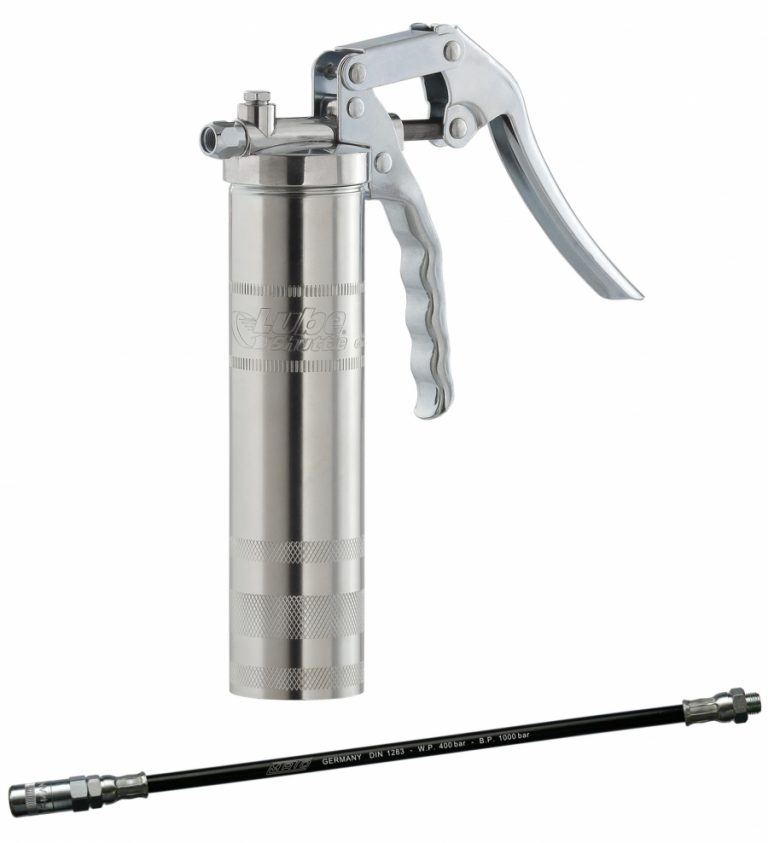
Recently, the makers of the Lube Shuttle grease system reached out to me, introducing me to a “new world” of grease technology. Finally, a grease gun with no plunger! No way to leak grease out the bottom end.

Tubes are threaded for easy attachment to the gun. If you use multiple types of grease, you can easily change tubes, even when a tube is partially used. Just put the cap back on the partially used tube and set it aside for later use.

How To Purchase

If you purchase directly from the Lube Shuttle store, you can enter coupon code TTWT to receive a 5% discount on your entire purchase. WooHoo!

There are several packages available. I would suggest considering one of the packages with a grease gun and 10 tubes of grease to start your collection.

Type of Grease

I find it difficult to know which type of grease is best for my situation. When I read the recommendations by each type of grease, they often sound just alike to me, so this becomes difficult. I asked the Lube Shuttle guys to help with this. After they attempted to explain to me repeatedly, I think I can summarize as follows:

  • G2 – Good general purpose grease. Probably the most applicable for equipment like mine
  • G200EP – Heavier grease than G2. Consider this a higher grade or premium grease.
  • MoS2 – Better yet, but likely not much benefit over the other two grades for typical small tractor usage

Overall, they suggested that our viewers select G2 or G200EP. If you have more questions on the applicability of the different grades of grease, I’ll have to refer you to Lube-Shuttle. This discussion quickly rose above my ability to comprehend. Of course that isn’t too difficult 🙂

Accessories

There are a couple of accessories you might want to consider with your order. First, I find a locking coupler to be incredibly effective. Lube Shuttle offers what they call the “safeLOCK” coupler. I don’t have a lot of experience with it yet, but it seems to be effective. I find it a bit more difficult to lock on to the fitting than the competitor’s model, but I was told it would “loosen up a bit” after I used it some more.

If you already have the Lock-n-Lube coupler, there is an adapter necessary to connect it to the metric hose on the Lube-Shuttle Gun. I’m including a link here to that adapter to make it easier for you.

Another accessory, recommended by my brother Tom is an extra-long hose. Tom is a big fan of the 3 ft / 1 meter hose because it allows you plenty of flexibility with the location of the grease gun. Often there is not a lot of room for you, and the grease gun to be within arms length of the fitting. With the extended hose, you can get the grease gun out of the way.

Your Feedback

I’m interested in hearing your results with the Lube-Shuttle system in the comment section below. Have you tried it? Does it work for you? If not, what is holding you back?

If you haven’t seen it yet, be sure to take a few minutes to see the Lube Shuttle in action in this video:

Tim

89

Tim grew up in a very rural area in southeastern Illinois. In fact, to this day, there is not a stoplight (red/yellow/green) in the ENTIRE COUNTY (Edwards County, IL). The county has one high school, and Tim was in the last class containing more than 100 students (103). Since then, this rural community has declined even further in population. An unfortunate situation facing many midwestern communities.

Tim’s family has farmed in Edwards County Illinois for several generations. While Tim enjoyed the lifestyle in that community, including strong family values, good community interaction, etc. He discovered that he also had a passion for computer software.

So, after high school, Tim ventured ‘up north’ to the University of Illinois at Urbana Champaign to earn a B.S. in Computer Science. After college, he took a position with IBM in Research Triangle Park, NC where he met Christy and they were married in 1992.

After IBM, his career in software has led to moves to Chicagoland (Grayslake/Gurnee, IL), then to Columbus Indiana, and in 1998, he and Christy moved to Carmel, IN where they lived until Tractor Time with Tim outgrew their 1/2 acre property.  Forced to seek more space, they relocated to a 10 acre property near Lebanon, IN.

Tim worked as a software architect and developer for 30 years before hanging up the keyboard and turning to “tractor play” full time with Tractor Time with Tim.

Tim found tractor work to be a therapy of sorts from the stressful days at the office. It is rewarding to be able to help folks quickly solve lawn cleanup and other outdoor issues quickly. Equally rewarding is meeting quality people in the area. We hear too much about the negative aspects of our society. Tim has found that our typical DIY focused clientele are down to earth folks who love to work, love to have fun, and love to see their yards cleaned up.

Eager to share this new found enjoyable hobby with others, Tim, Katriel, and Christy started the Tractor Time with Tim YouTube channel. Now, thousands of people have experienced the fun and fulfillment of compact tractor ownership. Tim hopes that he has been able to help folks smile just a little more!

How we got started on YouTube

30

We are often asked how we got started on YouTube. The story begins LONG before YouTube even existed. Unfortunately, we didn’t decide to start uploading videos other than piano concerts etc., until 2015. …but let’s rewind…

Tim has always had a passion for home video. Shortly before Katriel was born, he bought a $2,500 “the best you can buy” consumer level Mini-DV camcorder. This device recorded the family fun for many years to come. Video editing was difficult (and expensive) at the time. Tim wasted many hours and $$ trying to make decent videos. Each of these videos would be put on DVD, and mailed to the ‘grandparents’ so that they could see the exploits of their brilliant and beautiful grand-daughter 🙂

In 2014, Tim finally convinced Christy that he NEEDED a tractor! This was no small feat, as the < 1/2 acre plot where they live could be mowed with a push mower (assuming Tim didn’t eat so many cheeseburgers).

Since both sets of grandparents were farmers (more on that in Christy’s write-up), they were intrigued by the tractor and our (lack of) need for it. Technology had moved ahead, so now we started posting videos on YouTube for them to watch since it was easier than creating and mailing DVDs. These early videos (Cultivating Corn with the 1025R, John Deere 1025R Hilling Potatoes and Corn with Disk Hillers) had no editing whatsoever. This is the footage shot from the camera, with nothing removed. We had learned from years of experience to “stop shooting when it gets boring” so that we didn’t need to edit (remember how I mentioned that editing was ‘painful’).

I’ll link those first videos here in case you haven’t been forced to watch them yet.

Anyway, shortly after posting these first videos, we noticed that they had 150+ views. “Hey, we don’t have THAT MUCH family! Who is watching these videos?” So, we uploaded another set of videos (John Deere 1025R Tree Moving)…again, no editing at all.
We saw the view counts increasing, and folks began to comment on our videos. We decided to monetize the channel, and it became a challenge to earn our first $1. We had a family party (over cheeseburgers of course) at 100,000 views. It just seemed like a fun challenge at first. Later, we noticed how rewarding it is to provide some wholesome (some folks say therapeutic) entertainment. Viewer comments have been our primary motivation through this whole process. Certainly more motivating than the $226 we earned from YouTube in that first year (2015).

Thanks very much for your positive feedback, and for becoming our friends. In some cases, almost family.

Garden Tilling

9

Are you in Hamilton County, Marion County, or southern Tipton County Indiana? Do you need your garden tilled? We have the perfect tool for the job, and we would love to help.

Quality Results

Our tractor attached rototiller does an impressive job of tilling.  If you have experienced only walk-behind tillers, you will be quite surprised at the results.

We till each garden plot at least twice.   Depending on the situation, we might give it a third pass.    Our goal is to leave your garden in perfect seedbed condition.    We have yet to have a customer disappointed with the results left by this tiller.

The tiller will till approximately 4-6″ in depth, leaving a ‘fluffy’ seedbed.

The following video provides some illustration of our work.

Why Till?

Soil compacts and harden during the long winter season and weeds can begin to grow. Tilling the soil will kill the weeds and loosen the soil creating pockets of space which allow air and water to penetrate the soil. Seeds and young tender plants need the air and water in order to germinate or grow. Tilling gives your garden the best possible chance at producing a bountiful crop of veggies.

When Is the Right Time to Till?

Often people are not sure when to till their garden. If soil is tilled to wet, when the soil dries, you’re left with hardened clods that are difficult to break apart. Vegetables do not grow well in this environment. If you wait until the soil is completely dry – well, you might never get the garden started since it’s often rainy in the spring.

Watch this video on how to tell if your garden is ready to be tilled.

Want to Till Sod?

If you have not previously had a garden, you may need to till up sod. This is best done with a PTO powered roto tiller on a tractor. The walk behind tillers you can rent are ok if you already have a designated garden space but will not till sod easily or completely.

Steps to create a garden from sod:

  • Mark off the exact area for the garden
  • Spray the area with Round Up to kill the grass and weeds
    • You will get grass in your garden if you don’t do this step
  • Wait at least 7 days – 14 days is best
  • Mow the area as low as possible with your lawn mower
  • Have Tractor Time with Tim till the area with our compact tractor

What to Expect?

We will arrive with our tractor and tiller on our trailer.  After a quick unload, we will discuss the details of the project with you.  We will be asking questions like:

  • Are there any hidden obstacles?
  • Have you called 811 to have utilities marked (if a new garden)?
  • Do you have any specific preferences on how the garden is tilled?

We have a small tractor that will not tear up your grass. It will not leave ruts in your yard.  In fact, we use this same tractor to mow our lawn.

If you have a gated yard, we need at least a 53″ opening (gate) in order to enter the area. It is your responsibility to measure the gate and assure us that we can get to the area you want tilled. We will not remove a gate – but you can remove your own gate if necessary.

We will complete multiple passes with the tiller in your garden area. This completely stirs up the soil leaving it loose and fluffy – a great bed for flowers and veggies.