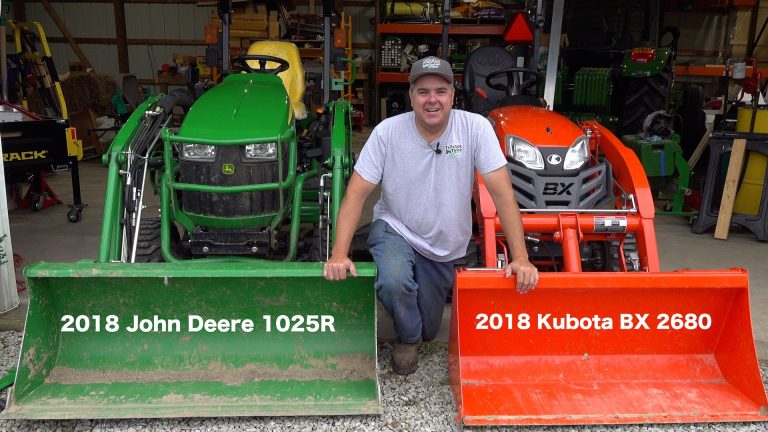
If you’ve been wishing for a single point hydraulic connector for your 1025r, wish no more! You can get yours from Green Parts Store today! We’re also excited to correct one area from our Kubota BX vs Deere 1025r comparison where the BX clearly defeated the 1025r.
The Single Point Connector Kit
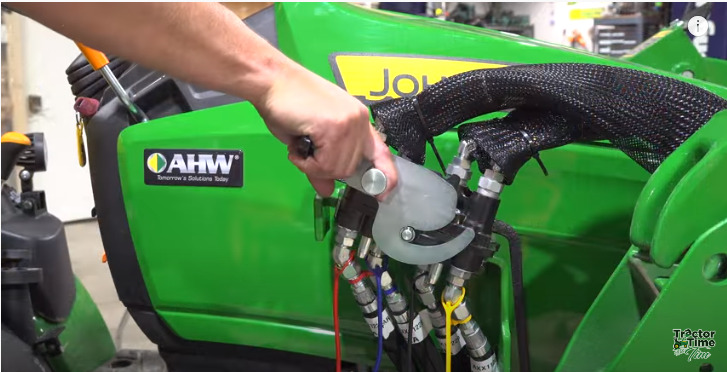
The kit has an impressive number of components. Overall there are 91 parts according to the contents of the kit. 91 sounds like a lot, but it isn’t really that complicated. 4 hoses for the tractor side, the single point connector itself, the bracket that mounts to the loader mast, 4 replacement hoses for the loader (shorter) and an assortment of nuts, bolts, and hydraulic fittings.
Go to GreenPartStore.com to pick up a kit of your own. In the video linked above I stated the kit cost was well over $800. However, Deere has reduced the price to $634.70. By using code TTWT at checkout you will get free shipping direct to your door on your entire order. Also, if you act by the end of 2020 GreenPartStore.com will send you the same hat you see me wearing in the linked video above FREE with your order.
Installation
Installation of the single point connector is relatively easy. No need for complex tools and while having an extra set of hands (or a Christy) may be nice, it isn’t necessary. You will need a 1/2 torque wrench capable of up to 250ft-lbs of torque! You can get one here: 1/2″ Torque Wrench From Amazon
Step 1 – Attach the Single Point Bracket
Start by removing the 3 bolts on the right side of the loader mast. Expect that these are going to be on there tight. This is where a large breaker bar comes in handy.
Tip: Remove the side panel to provide yourself with more room to get to the back side of the bolts should you need to get a backer wrench on there.
Once you have the old bolts out, you’ll put the bracket that holds the single point connector on using new longer bolts supplied in the kit. The replacement bolts are installed opposite of how the originals were due to their longer length.
Step 2 – Assemble the Tractor Side Fittings and Hoses
You’ll want to double check the order of the hose colors to be sure they are in the proper order. Based on how our kit arrived, my guess is the caps don’t get installed at the factory in a specific order. I would also suggest you only finger tighten the hoses to the connectors at this point. You’ll want the ability to rotate the hoses to the optimal position once you have them installed on the tractor.
Step 3 – Attach the Tractor Side Connector
Once you have the two bolts installed that hold the connector to the bracket, you’ll want to attach the couplers to the other end of the hoses. This is where having the ability to rotate the hoses into the best possible location comes into play. Since these hoses are stationary and remain connected to the tractor, they really just need to be positioned so that they are out of the way.
Step 4 – Attach the New Loader Side Hoses
This has to be the easiest step of this install. Famous last words? If you saw the video linked above, you’ll understand. If you didn’t, there is lots of good info in the video that you’ll want to see!
Tip: Be prepared with some sort of bucket or oil pan when you remove the hoses from the loader or you’ll end up with hydraulic oil on the ground.
Be sure to add the additional protective wrap to the hoses before connecting them to the tractor! Just another example of the thought that went into this Deere kit. Hydraulic hoses aren’t cheap, so protecting them is important. Of course you can pick up replacement hoses from DiscountHydraulicHose.com/TTWT should one of yours get damaged. Use code TTWT for a 5% discount.
Step 5 – Attach the Loader Side Connector and Holder
The manual suggests to connect the Single Point Connector to the tractor when installing the connectors. Before doing this, disconnect the quick connect hoses from the tractor or you’ll have another mess on your hands! Once the connectors are installed, pull the Single Point Connector from the tractor and hook-up the hoses from the loader.
The last piece of the kit is a bracket that gives you a convenient spot to hold the loader side connector. There are just two bolts to fix it to the top inside of the loader boom arm. That’s it, you’ve done it… now sit back an marvel at what you just accomplished. Well, maybe you should try it out first!
Summary
While it can be said that adding a single point connector to your 1023e, 1025r, or 2025r subcompact tractor may not be necessary, I can’t think of a better upgrade for our Johnny. If you’ve never struggled connecting or disconnecting the hydraulic lines on your loader, you have good strength in your hands, or you rarely remove your loader, then the impact of this upgrade may not be the same for you. Of course, if you are like us and you take the loader off frequently or have ever struggled to disconnect or reconnect the hydraulic lines, I highly recommend the genuine Deere kit from GreenPartStore.com. With the price now just $634 + tax and free shipping by using coupon code TTWT, you will not be sorry you made the investment.
Have you ever wondered what a sickle bar mower can do on a 1025r or other subcompact tractor? Today we have another Maschio mower from Agfolks.com. With the help of our friends at Agfolks.com, we hope to answer that question.
What is a Sickle Bar Mower?
A Sickle Bar mower is a reciprocating style of mower that consists of a long (~5 to 9 foot) bar that has triangular shaped blades or sections that move back and forth. The bar has fingers that we always call guards. Those guards prevent rocks and larger items from getting in to the cutter bar. The action of a sickle bar is similar to that of a hair clipper.
As a kid growing up on the farm we used an International Harvester 1300 Sickle Bar mower. As I mentioned in the video linked above, the IH 1300 is a quality sickle mower should a guy want to pick one up on the used equipment market. It might take a bit to get it configured so that a 1025r could pick it up, but it would be a fun adventure!
Uses of a Sickle Bar
A sickle bar is primarily used in the hay making process. Typically the hay is mowed on the 1st day and left to dry. On the 2nd day the hay gets stirred up with what’s called a Tedder and left to dry a bit more. On the 3rd day the hay is pushed into windrows using what’s called a rake. The final step is to then run a baler along the windrows completing the process.
General mowing opportunities also exist for a sickle bar mower. If you’ve got a ditch bank that you need to mow, this unit would be a great option. With its light weight, you can safely cut with the tractor on uneven ground without the feeling of tipping over. It would be very useful at trimming underneath the low hanging branches of pine trees or other such obstacles.
Pros and Cons of a Sickle Bar Mower
After using the Maschio sickle bar mower we got from Agfolks.com, we found there to be a number of pros such as:
They are simpler, less expensive and lighter weight than a disc mower
It’s cleaner as it won’t throw grass or other items at the operator
The operator drives along in an already cut path resulting in fewer bugs flying around
They are quieter than other types of mowers
Here are a few of the cons we noticed:
It leaves the grass in one piece and just sort of lays it over
The look is less desirable to those who are mowing to make something look nice
There would be more maintenance with a sickle bar mower
Maschio
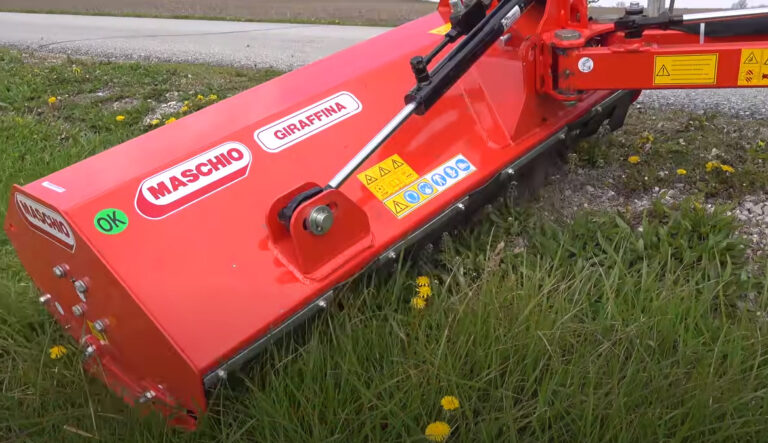
The Maschio Weekend Warrior Fiore 175 has a 69″ cutting width. As I mentioned in the video, this same company manufactures a sickle bar mower with green paint and sold under the Frontier brand. One unique features of the Maschio mower is that both the sections and guards move increasing the speed this unit will cut.
When you visit Agfolks.com, you will see there are several variations of the Maschio sickle bar mowers. If you go with the unit like the one we showed in our video, don’t forget to visit Discount Hydraulic Hoses in order to pick up the Hydraulic kit that we’ve put together for you. Remember to use coupon code TTWT for 5%off your purchase at checkout! If you’d prefer a simpler option, Maschio does offer a mechanical lift option.
Summary
A sickle bar mower, like this Maschio, is easy on the tractor. It doesn’t come close to maxing out the horsepower of subcompact tractor. It’s a great mower for trimming and cutting underneath things. While a Sickle Bar Mower’s primary use is cutting hay, I hope you’ve seen some of their other uses of this versatile mower. Check out Agfolks.com for this and other Maschio products! Don’t forget that by using coupon code TTWT at checkout, you’ll save 5% off your entire purchase.
The Maschio Weekend Warrior Side Offset Flail Mower is a very versatile piece of equipment. Is it right for your situation? We hope to answer that question and more in this article on our video by the same title and linked below.
So why are they called Flail mowers?
The mowers consist of a drum that spins with attached flails, sometimes referred to as blades. Without going too far off topic, I feel it wouldn’t be fair to not explain the name a bit more. Flails are an old agricultural tool used in the threshing process. Flails consisted of a long stick connected to a shorter stick by a small chain. They were used to beat the grains to separate them from the stalks.
By having the flails attached to the drums in such a way that they are free to swing, flail mowers tend to be safer than rotary cutters (aka brush/bush hogs). When a flail mower encounters an immovable object (rock, stump, etc.), the blades breakaway instead of throwing the object from the mower. We’ve definitely experienced objects flying out from the underneath our rotary cutters!
The flail mower spins in a reverse direction sort of like a rear tine tiller does. This action tends to lift the grass up before it cuts it. It also tends to keep the grass inside the mower longer giving you more of a mulching effect. This reduces the amount of stuff you’ll see flying out as well.
Did someone say Hydraulics?
An offset flail mower requires additional hydraulic connections which many of us don’t have available at the rear of our tractors. In addition to raising the mower up and down as you would with a typical 3-point mower, the offset configuration requires you to be able to both tilt and extend the head of the mower. By removing the FEL and running extra long hydraulic lines, we created a ‘poor man’s rear SCV’ that gives us the additional functions we needed. We worked with Discount Hydraulic Hose to develop a kit with all the required parts for this approach. About $100 for the kit, after applying code TTWT for the 5% discount.
While this works great for occasional use, we are working on a better (although more expensive) solution. More information on that later. When we need hydraulic fittings, hoses, adapters, etc., Discount Hydraulic Hose is our choice. Remember to use coupon code TTWT for 5%off your purchase at checkout!
So how did Johnny do?
Overall this experiment was successful. We were able to trim around trees and other objects that otherwise would have caused us trouble. The 53″ FIXED Maschio Flail Mower would work well for a sub-compact tractor like Johnny or even the Kubota BX series. The offset flail may be a bit much though. I think the smaller 47″ Maschio Offset Flail Mower unit might be manageable on a subcompact due to it being slightly lighter. Johnny had a little trouble lifting the unit we tested, and when fully extended, the 1025r was a bit tipsy. We plan to try it with the 2038r when we get a chance. We expect it will be a good fit on this tractor. You can check out the larger unit we tested with Johnny or the others linked directly above by visiting Agfolks.com. Remember to use coupon code TTWT and you’ll save an extra 5% on their already great prices!
Summary
We really enjoyed trying out this offset flail mower on Johnny. We see several advantages of going with a fail mower over another style of mower.
Flail mowers tend to be safer given their design and rotation of the drum.
Flail mowers keep the grass in the chamber longer seemingly giving you more mulch
You can cut lower than you would with a rotary cutter
The cut quality was not affected by the tractor having first mashed down the grass in front of the mower. This really surprise us and I think makes a strong case for going with the fixed flail mower from Maschio.
While I may not recommend an offset for a sub-compact the size of Johnny, if you’ve got a pond bank or a steep ditch you could manage it with that 4′ version. Once you get up into the large frame 2 series tractors, you won’t have any problems. We’d love to hear your thoughts after seeing our video and reading the article!
Many of the tractors and other equipment we use tend to make noise. While we were reluctant to promote a headset on our channel at first, after using the noise isolating headsets on a few of our projects we were convinced. Having the ability to listen to music or answer a phone call all while protecting our hearing helped us to be more productive. As a result, we’ve partnered with to offer you a special deal.
By using using this link and entering special code TTWT at checkout you will receive 10% off per pair of that you order.
So many options… how to choose?
offers a number of variations, from wired to wireless. Each headset includes 3 sizes of the sound deadening tips so you can ensure you have the correct size for your needs.
My favorites and the ones you’ll see me wearing most often in our videos are the ® Xtra. With as often as I need to take them out to communicate with the customer or to communicate with Christy, I find the combination of the cord and the magnet help me from losing them! The magnets serve a dual purpose by allowing you to stop your music or answer a call. The ® Xtra are Bluetooth 4.1.
The other headset I enjoy are the ® FREE. The earbud style wireless headset doesn’t bother the back of my neck on particularly hot and humid days. If you don’t find yourself needing to take them in and out as we do in our videos, then these could be the ones for you. Christy enjoys these when she’s cleaning around the house. The ® FREE are Bluetooth 5.0 and have an impressive 7+ hour talk/music play time and 120 hours of standby.
Summary
Folks, these noise isolating headsets are well made and come from an Indiana based company. They offer Noise Reduction Ratings (NRR) from 22 to 27 to protect you from hearing loss. Some folks may not find the audio quite loud enough. Usually this is the result of the earbuds not fully sealing the outside noise. Pick up a pair of these for yourself or better yet get a pair for your loved one. They make excellent Birthday, Father’s Day ( Mother’s day too!), Christmas, Anniversary… basically any occasion you can think of… gift!
After taking a close look at the mower in Round 2, we’re now ready to do some actual mowing tests.
As with prior rounds, the video episode likely provides better visualization of these tests than the written word. Please check out this episode below
Uncut Circle (Turning Radius)
The specifications on these tractors list the turning radius as follows:
Deere 1025R – 7.4 ft
Kubota BX 2680 – 7.5 ft
Based on our testing, it is difficult to understand where these numbers came from. I am not sure how they are measured.
After some discussion, we decided that ‘uncut circle diameter’ would be the best way to measure and demonstrate how these tractors compare when turning.
First, remember that the Kubota BX has a 2″ shorter wheelbase than the 1025r, and it is 2-3″ narrower as well. With these smaller dimensions, it is reasonable to assume that the BX is more maneuverable than the 1025r. In fact, we see many comments saying, I chose the smaller BX because it is more maneuverable.
Our tests did not agree with this assumption. We found the uncut circle diameter to be:
Deere 1025r – 50″
Kubota BX – 78″
This was the most surprising test result we have seen to date. Having said that, we were already aware that the BX didn’t turn nearly as sharply as the 1025r from our basic usage. We just didn’t realize the difference would be so dramatic.
Fuel Consumption
I filled the fuel tank on each machine to the ‘base of the neck’ on the tank. …adding more after each ‘gurgle’ until the gurgling stopped and the fuel level was just above the neck line.
I then mowed at full throttle for exactly one hour. I used a timer 🙂
I measured the amount of diesel required to refill to the same level.
As usual, I tried to perform this test as accurately as possible. However, I am not entirely confident in the results. Perhaps I should have mowed for two hours each? Perhaps I should have filled the tank all the way to the top of the rim?
Anyway, we found the following:
Deere 1025R 1 Gallon + 16 ounces
Kubota BX 2680 3 Quarts + 8 ounces
Hillside Stability
We could not find a way to do an objective hillside stability test. So, we chose to use a subjective approach. Christy and I each drove the mower along our ditch bank. We discussed how each machine ‘felt’.
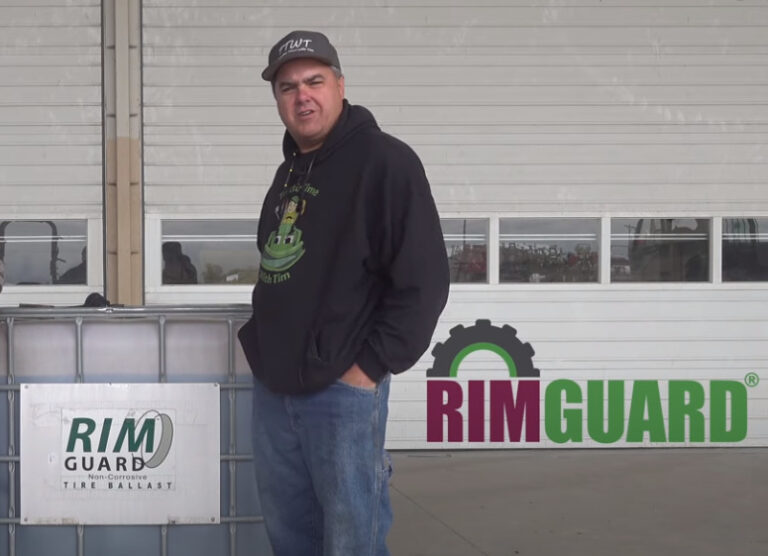
Both machines have the rear tires filled with Rim Guard. This improves the stability dramatically. Rim Guard is the heaviest fluid available for tires. These little tires can hold 100 lbs each. This 200lbs is very near the ground, lowering the center of gravity, dramatically improving hillside stability.
We found the two machines to perform quite similarly on the hill. Perhaps a small edge to the Deere. However, the reduced deck lift height turned out to be relevant in this test, hindering the handling of the tractor on the ditch bank.
Scalp Test
We mowed 3 different angles along our ditch bank. I chose this particular area because I had experienced some scalping here with the 1025r before.
The result was inconclusive. Neither machine scalped on the test strip. Quite frankly, we ran out time for more significant testing.
Having said that the front roller of the BX deck should reduce the scalping.
Noise Level
See video
Underside of Deck
See video
Cut Quality
Our grass was so dead that we were not able to do an adequate job testing cut quailty.
Subcompact and compact tractors, no matter which brand have a common weakness. They are simply too lightweight to be fully effective. Adding weight to these machines can be the most cost effective performance improvement possible.
Location of Ballast
We’ll discuss two popular locations for ballast on small tractors. Weight can be added on the 3 point hitch, well behind the tractor’s rear axle. Weight can also be attached on our around the tractors rear axle. Let’s examine the purpose and benefits of each one.
3 Point Hitch Attached Ballast
3 point hitch ballast is the most effective ballast for the front end loader. It relieves strain on the front axle by using the rear axle as a pivot point. We discuss 3 point hitch ballast frequently on our YouTube channel, and we highly recommend following the owner’s manual recommendations for 3 point hitch ballast. Check out Heavy Hitch for our recommended 3 point hitch attached ballast…don’t forget to use code TTWT for a 5% discount!
While 3 point hitch ballast is incredibly important, this article is focused on the second popular location for ballast…
Axle Mounted Ballast
Another important location for ballast is on or near the rear axle. Rear axle ballast has many advantages:
Lowers Center of Gravity (COG) to reduce tipping hazard. Tipping is a major concern with sub-compact tractors.
Does not add strain to the axle, 3 point hitch, etc.
Increases the ride quality by reducing ‘bounce’ while driving on rough terrain.
Increases traction when pulling heavy items (disks, trailers, logs, etc)
Types of Axle Mounted Ballast
There are two primary choices for axle mounted ballast. Wheel weights, or tire fluid. These choices are not exclusive. You can select BOTH fluid AND wheel weights to maximize the ballast on a sub-compact tractor. In fact, I would recommend you do exactly that! You’ve likely seen our first 1025R perform some heroic tasks in many of our YouTube episodes. The double-dose of axle mounted ballast, both Rim Guard and wheel weights give Johnny the extra boost necessary to get the job done.
Having said that, our 2nd 1025r currently has only Rim Guard for axle mounted ballast. We have three reasons for choosing Rim Guard vs. wheel weights.
Cost. Rim Guard is much cheaper than cast iron. This is exaggerated even more with recent tariffs.
Hassle. We find that once installed, Rim Guard is out of sight and out of mind. We don’t have to worry about it. It does not take up any space other than useless space inside the tire!
Loyalty. Rim Guard is made from beet-juice, grown by North American farmers. Cast Iron comes from China and/or India!
How do I get it?
Click here to find your closest Rim Guard supplier. This is usually a local tire shop or equipment dealer. Doesn’t matter if the equipment dealer sells a different brand of tractor than you have, they will happily fill the tires on your tractor.
For example, we recently had our second 1025r tires filled at a local John Deere dealer. Check out the video here:
Installing Rimguard in our 1025r rear tires!
Summary
We haven’t really discussed the reasons for Rim Guard over other tire fluid options in this article. There are several. 1) It’s heavy! The heaviest fluid available. 2) It won’t hurt anything!…not your rims, not your grass or your cats if it happens to spill, etc. 3) It won’t freeze.
We’ve used Rim Guard in our equipment since 2014 when we first got Johnny! We have no plans to change directions now, and we highly recommend it for your compact tractor.
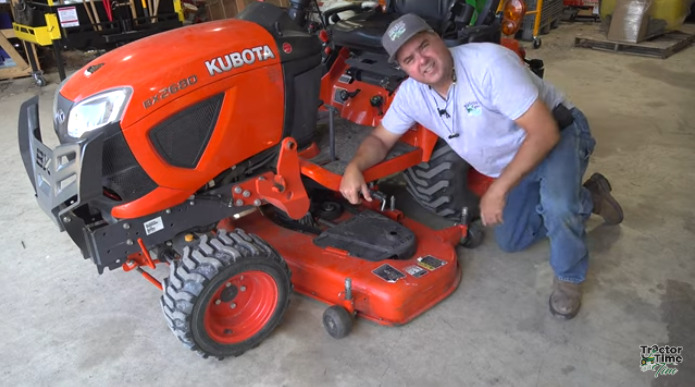
Turns out, there is LOTS more discuss about the mid-mount mowers on these machines than we could cover in a single round. So, we’ve split this topic into two segments. First, we’ll cover some measurements, difficulty of installation/removal, and other items related to the mid mount mower. Round #3 will be focused on operational aspects of these tractors with the mid mount mower.
The video goes through all of the following points. The visuals along with the descriptions are probably easier to understand than this written version. Check it out here:
Round #2 Mower Setup and Specifications
As with Round #1, this episode generated many comments, and shall I say “suggestions for improvement”. So, we created a follow-up episode addressing
Deck Lift Height
The BX has a solid advantage in mower lift height. It can lift the mower to at least 6″ off the ground. The 1025r is only able to manage about 4″. This extra 2″ proves quite useful.
When mowing, there are often obstacles which need to be avoided. Or, perhaps some difficult terrain. For example, a ditch bank which must be mowed, but would be scalped, or worse if the mower is forced to ‘drag’ over it. I see this occasionally around culverts and other driveway entrances.
Another advantage of the increased mower lift height as often mentioned by BX owners is that the mower does not need to be removed as often. Some light tillage, grading, or loader work can be performed without removing the deck.
Deck Removal and Installation
Not much brings out the strong opinions and hateful comments in the BX/1025r debates as quickly as the topic of “drive over decks”. Therefore, we feel it is necessary to go into significant detail on how the two deck installation mechanisms differ.
BX Drive Over Deck
The BX drive over deck gets poor reviews across the board. I have never experienced one, so I do not have any opinion, nor any ability to comment on its effectiveness.
My understanding is that even with the BX drive over deck, one must still hook up the PTO shaft by hand.
It is entirely possible (personal opinion here) that the Kubota mindset of “I hate drive over decks” directed at John Deere has had a negative impact on the Kubota Drive over system, and has consequently lowered the sales and attractiveness of this system.
Whatever the reason, we are not able to review the Kubota drive over deck system. We can’t even find a user who has one to get their personal feedback. Therefore, we will proceed with the standard BX deck, as it is obviously the most commonly sold mechanism on the BX system.
BX Removal Steps
You can see a good video describing the steps to remove and reinstall the BX deck from Neil Messick here. I used this video learn how to do the removal process. While Neil does a great job of showing us “how” to do the removal, the editing makes the actual removal look a bit easier than it really is.
Neil Messick on BX mid mount mower deck removal and installation
To simplify, I stated the process this way. “Remove from front to back”, and “Install from back to front”
Rotate gauge wheels (Neil skipped this step)
Lower and remove front brackets
Detach lift brackets (rear of deck)
Detach PTO shaft
Drag deck out from under the tractor
BX Installation Steps
As mentioned above “Install from back to front”.
Slide the deck (mostly) under the tractor. Leaving it not quite all the way in leaves more space for step #2
Connect the PTO shaft. (Line up the splines before worrying about sliding the collar. Once splines are lined up, slide the collar back while pushing the shaft on).
Slide the mower the rest of the way in and line up under the lift points on the tractor.
Lower the lift mechanism (3 point hitch)
Pin the lift points to the deck
Mount the front brackets to the mower and tractor and lock them up.
Raise the deck with the tractor
Rotate wheels to mowing position.
BX Removal/Installation Summary
This deck attachment approach is much better than a traditional lawn mower. Kubota has made this about as easy as possible without choosing the drive over and auto-connect approach.
Still, it is not trivial. At a minimum, you need to get on your knees multiple times, and given the soreness in my knees, and lack of visibility from that angle, I usually end up on my back. This removal is best done on a smooth concrete surface. Dragging the mower deck across rocks or grass will be more difficult.
1025R Mid Mount Mower Options
There are two options for the 1025r. BOTH of these options are ‘drive-over’ options. So, there is no way to get a Deere 1-series mid mount mower without a drive over deck.
The base configuration requires that the PTO shaft be manually connected to the tractor. However, very few 1025r’s are configured this way. Most are sold with a $500 upgrade which connects the PTO shaft automatically as the tractor drives over the deck.
So, a potential misconception here is that ‘drive over’ and ‘auto-connect’ are the same thing. They are not. All 1-series decks are drive over. Most (but not all) are ‘auto-connect’.
1025R Mower Removal Steps
Removal of the mower is done as follows.
trip the levers at each of the gauge wheels to allow the wheels to ‘go up’
Lower the deck to the ground
Flip the lever over-center to allow the tractor to slide off the deck (use either side of the tractor…just in front of rear wheel)
Back off the deck (use 4wd)
Raise the 3 point and lock the mower attachment up so that it won’t be damaged while using other equipment.
1025R Mower Install Steps
Set the mower height control knob to ‘install’
lower the 3 point all the way.
drive over the deck
back up slightly to ensure the deck is attached
raise the deck with the 3 point. Set the height knob as desired
flip the levers at each gauge wheel so that they cannot ‘go up’ while mowing.
1025R Auto-Connect Adjustment
The drive-over / auto-connect system must be adjusted properly to work. Your dealer should do this adjustment for you before you take delivery. Once adjusted properly, it should not need to be re-adjusted unless something gets bent, comes loose, or otherwise changes.
In the event your system DOES need to be adjusted, there are several resources available to assist. Specifically, GreenTractorTalk.com has a great writeup on how to adjust the auto-connect system.
Most issues can be diagnosed and adjusted easily by analyzing the problem. Is the over-center lever tight and not allowing rotation? Does the deck slide forward instead of allowing the PTO to connect? Take a peek under the deck, and you can likely see the mal-adjusted item.
MMM Install/Removal Summary
The Deere auto-connect system is MUCH easier to use than the Kubota manual system. No one can objectively argue against that.
This is partially offset by Kubota’s higher max lift height. So, the deck doesn’t interfere with as many non mowing tasks.
The Deere system requires finesse and patience. It isn’t the place for a sledge hammer and impatience. However, with a little TLC, it works fine, and makes your tractor experience more productive.
ROPS Height
The BX2680 has a much shorter ROPS height than the 1025R. Just over 82″ for the BX vs. about 91″ for the 1025R. The BX23s backhoe version lists just over 86″ for its ROPS height.
The height of the ROPS is annoying when mowing. Personal opinion here….we would be safer with a lower ROPS height because folks would tend to leave the ROPS up more often.
We NEED to keep the ROPS in the upright position on these little tractors. They are simply too roll-over prone to ignore this.
Mower Gearbox
Gearbox Height
The BX gearbox has an unusually low profile. This catches the eye immediately when comparing the decks. Perhaps this low profile is part of what allows the deck to raise higher than the competition? In any case, it is clear that the gearbox was specially designed for this purpose.
Gearbox Attached to Blade
The BX gearbox is directly attached to the center mower blade. There is no ‘slipper’ mechanism for this spindle. Therefore, if the middle blade hits an immovable object, something serious will break. The 1025R deck center blade is belt driven like the outside two blades. This allows slippage to occur rather than immediate (and more expensive) gearbox damage.
Deck Height/Construction
I evaluated several areas of the deck construction. The deck thickness seemed similar between the two units. The Deere has a 1/2″ (or slightly larger) steel rod around the bottom edge of the deck which would better protect from bending upon impact. Other than that, I could see no obvious strength differences or issues.
Ease of shield removal
The BX deck has easily removable plastic shields over the mower belt and spindles. This makes cleaning and access for service easier. The corresponding shields on the 1025r deck are bolted on, and much more difficult to remove.
Opinion: Contrary to some, I believe that if a shield is easier to remove and reinstall, it will more likely be left in place by the user. If it is difficult to remove, the user is likely to leave it off once they take it off the first time.
Mower Lift Mechanisms
The BX offers only the standard 3 point hitch controlled mower lift.
The 1025r offers two additional options which lift the mower via a separate hydraulic control. Each of these frees up the 3 point hitch to operate independently of the mower deck. I have much more detail including part numbers and prices on the different lift options here.
Load ‘n Go
The 1025r deck now offers brackets which allow the loader to lift the mower deck for cleaning, service, storage, etc. These brackets are available at http://greenpartstore.com/ttwt You can get free shipping on these or any other parts order from greenpartstore.
Summary
Most of the items in the above comparison are very similar. Small advantages on one side or the other. However, one major area stands apart. The Deere Auto-connect system far outshines the BX deck attachment system. Given the multi-use multi-function nature of these tractors, this round goes soundly to the Deere 1025r
Round #3 will focus on the operational aspects of mowing. Turning Radius, Hillside stability, Noise level, etc.
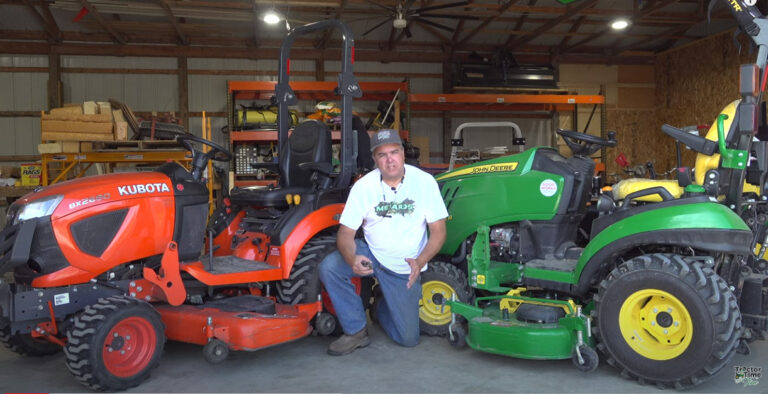
We are attempting to do an in depth user oriented review and comparison of the Deere 1025R and Kubota BX 2680.
We intend to cover practical items which might be missed by the specification sheet, or a quick dealer walk around. This comparison will take multiple episodes, so if you don’t see a particular area of the tractor listed here, keep watching. We will go over each major function of the tractor in as much detail as possible.
We do not have access to a BX23s, so we cannot compare backhoe functionality.
Our Bias Stated Explicitly
We believe that no one can do any product comparison without some bias. It is simply impossible. We can only promise to do our best, using objective tests where possible, and openly stating that we are being subjective (using our opinions) at other times.
We believe it is best for us to discuss our bias and background up front. You can then view the videos and read the write-ups with that understanding.
Our Equipment Background
We have owned two Deere 1025r tractors, starting with a new 2014 model, and now we own a 2018 model.
Our Dealer Relationships
We have a marketing relationship with AHW LLC. Details of this relationship are available here.
As we have encountered Kubota specific questions, we have reached out to Messick’s. Neil Messick (YouTube) is a friend of this channel, and has been very helpful throughout this review.
Ok, with those points aside, let’s get started with the review!
Round #1 leans Kubota due to the much higher 3 point lift capacity. However, the lack of position control is a major missing feature. So, while Kubota wins, it was not a resounding victory.
In the opening round, we’ll investigate the 3 point hitch. lift/lower vertical range, lift capacity, physical spacing and size, stabilizer / sway bar design, etc.
If you have not seen the video for this episode, we would encourage you to watch it before proceeding. The video walkthrough really helps to see the similarities and differences.
Additionally, each of the items discussed below have good video showing the measurements. Much easier to visualize than to read with words on the screen!
Round #1
This episode brought lots of feedback in the form of both questions and comments. To respond, we created a follow-up episode. Here it is:
Lift Arm Geometry & Spacing
The Deere lift arms are longer. Roughly 25.5″ from pin center to pin center. The Kubota BX measures roughly 20.5 inches. What does this mean?
Attachment Compatibility
This extra length provides more space between the tractor and the attachment. Some attachments may have forward protruding elements. For example, a plow might have a coulter which sits forward of the 3 pt hitch connection. It would be more likely to fit on a 1025R than on a Kubota.
We measured from the PTO shield straight back to even with the 3 pt lift pins. 15 1/2″ on the BX, 17 1/2″ on the 1025r. Combined with the sway-bar / stabilizer differences, there is a significantly larger space inside and in front of the lift arms on the 1025r.
Lift Capacity
The shorter lift arms provide better leverage, and therefore create an advantage for the BX. In our testing, the BX lifted roughly 1265lbs via our Heavy Hitch Bracket The 1025r lifted roughly 1065lbs with the same bracket.
Lift Range
I expected the longer lift arms of the Deere to have a broader lift range (lower minimum height and higher maximum height). However, this did not turn out to be true. The BX lifted to 25 1/8″ while the 1025r lifted to 23 1/2″.
On the mimimum (lower) end, the BX dropped to 8 1/2″ while the 1025r dropped to 8 3/4″
Stabilizers / Sway Bars
Each machine has anti-sway bars (I called them stabilizers in the video). This allows the user to either allow the 3 pt to sway, or to restrict it to a single position while pulling an attachment. For example, when tilling, it is preferable to keep the tiller directly behind the tractor, and not allow it to freely move left or right.
The design of these stabilizers is opposite on the two machines. The BX has the stabilizers between the lift arms to keep them from moving outward. The Deere has the stabilizers on the outside of the lift arms to keep them from moving inward.
At first glance, this seems like a non issue. Either approach works fine for keeping the attachment lined up properly. However, when one attempts to unhook an attachment, they encounter the difference.
Without a quick hitch, one needs to pull the lift arms outward to remove from the lift pin on the attachment. The BX approach does not allow this without loosening the stabilizer turnbuckle. The Deere approach allows the arms to move outward (as discussed above), so they can be pulled off the attachment pins.
When nothing is attached, the BX approach works nicely, gravity keeps the lift arms pulled inward. For the 1025r, you’ll need a bungee cord to keep the arms together when nothing is attached to them.
As hinted above, a 3 point quick hitch makes this a non issue. Check out our article describing the different quick hitch options available for compact tractors. We highly recommend one of these!
There is a 3rd party sway bar upgrade available for BX tractors. Check out this site for details: https://www.stabilworks.rocks/
Control Mechanism
The BX uses a simplistic up/down control lever for the 3 point hitch. Pull back on the handle to raise, push forward to lower. Release the lever to stop lifting/lowering. This functions just like the loader joystick. As far as I know, all other sub-compact tractors (except 1025r) use the same type of control.
The 1025r uses a much more precise control. The lever controls the actual position of the implement. For example, set the position control to ‘5’ and it will lower the implement to the exact same position each time. Most larger compact tractors, and ALL farm tractors use this approach.
If you have never used a tractor with position control, you likely don’t appreciate what you are missing! This feature makes using a box blade, rotary cutter or other 3 point attachment MUCH easier.
Summary / Conclusion
The Kubota BX lifts more, lifts it higher, and lowers it lower than the Deere 1025r.
The 1025r has a better sway bar / stabilizer solution. However, there is a 3rd party upgrade available for the BX which could improve this BX weakness.
So, the final decision on this round comes down to 3 point position control. If you find that important (as I do), then the 1025r wins, as there is no equivalent BX solution. If you are content with the more simplistic up/down control, then the BX wins this round hands down.
Hope you enjoyed this round. Stay tuned for further episodes comparing other areas of these two incredible machines!