Are you tired of lifting 5 gallon cans, and spilling fuel all over your new tractor? I feel your pain. When I first got my tractor, I quickly decided that I was not going to cart fuel to it in 5 gallon plastic cans.
However, having just spent 5 years worth of playtime budget, the finance committee (Christy) was in no mood to approve a large expense for fuel storage. So, it was time to cobble something together.
I started with a phone call to my brother asking if the farm had a used 55 gallon oil drum in decent enough condition to store diesel fuel. He started with a used 15w-40 engine oil container. He cleaned it up by rinsing it repeatedly with diesel.
Once cleaned up, I washed the oil off the outside of it and painted it yellow to signify diesel fuel. (I have yet to get a DOT sticker with the same indication).
The two bung holes in the 55 gallon drum came in very handy. The larger bung-hole is used for my hand pump. Use the amazon link to the right to see (and/or purchase) the pump I have.
I’ve made a few changes to the solution as time progresses, and I will continue to make modifications as time and money permit. For instance, my next modification will likely be a filter just after the hand pump as a bit of an insurance policy against dirty fuel, or dirt in my fuel barrel.
The video below provides an overview of the entire process I use to refill my fuel container. I hope you’ll find it helpful as you think about how to improve your fuel storage solution.
One of our viewers pointed out that Paul Short had put together a video on his fuel storage solution. I watched it…again AFTER we had published our video. It is surprising how close our solution is to his. He chose a 110v electric pump. I wanted the simplicity of a hand powered pump (it cranks easily, and doesn’t take much to fill up the tractor). He has a dolly to roll his barrel around. I’m going to link his video here as well so that you can see another similar example.
One obvious missing feature on the 54D/60D auto-connect decks is the center anti-scalp roller. Almost all mower decks of this size have center rollers.
Before we start to question the Deere engineering staff’s intelligence, let’s see if there is a better explanation.
The reason is related to the approach used to “disconnect” the deck from the tractor. The first step is to release the gauge wheels so that the deck sits on firmly on the ground.
This allows the front tractor tires to climb up onto the deck. If the deck were free to roll, the tractor would push the mower around rather than rolling up onto the deck.
Equally important is the distribution of the tractor weight on the deck while the tractor is on top of the deck. The rollers are not designed to handle the weight of the entire tractor. So, lowering the deck all of the way to the ground distributes this weight evenly around the edges of the deck.
Now that we understand why Deere didn’t include a center roller, should we be adding one ourselves? The first issue (keeping the deck from rolling while connecting/disconnecting) is a simple test. If you scoot the deck all around your yard when trying to drive up on it, then perhaps your roller isn’t working out very well!
The second issue (weight distribution when tractor on top) is more difficult. My design uses two approaches to deal with this issue:
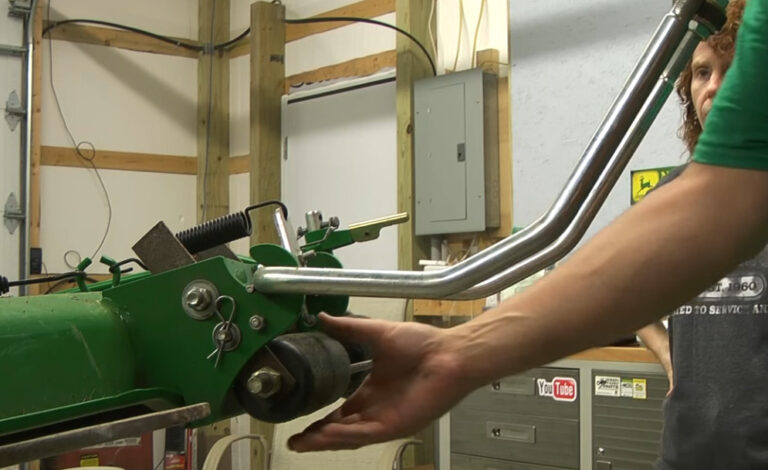
Mount the roller only a small distance (1/2″) below the frame of the deck. My thought was that the deck (and center roller) would flex enough to disribute the weight to at least a portion of the deck.
Provide a mechanism to release the roller so that it flexes upwards when the deck needs to be removed. You’ll see this solution in the video. However, in practicality, I rarely/never use it, even on concrete.
So, let’s get to the solution. I bought the roller via amazon (link below). I bought a 3/16 x 1 1/2 x Length 12 (maybe 24?) at Menards. I included a link to a similar piece below.
I used a single 5/8 x 8 bolt, 2x 1/2 x 1.5 inch bolts, and a single 5/16 x 8 inch bolt. I bought lock-nuts for teh 1/2 and 5/8 bolts, and I drilled a hole in the 5/16 bolt so that I could use a cotter key for quick release.
I wanted to be able to release the roller so that the deck could lower to ‘install’ position, with the deck fully on the ground. So, the 5/16 bolt is removable. When removed, the roller can freely flex upward allowing the frame of the mower deck to sit firmly on the ground for connecting and disconnecting.
After experiments, I decided that I don’t really need this feature, but I would not have felt comfortable without it.
Here is a video showing the complete process. Hopefully this will help you design/build your own anti-scalp roller.
Your feedback is welcome. Just add a comment below!
I’m providing some quick links below for purchasing mower blades from greenpartstore.com. Use coupon code TTWT at that link to get Free Shipping.
If you need blades for another model, please use your owners manual as a reference for the part number(s).
If you need parts for other deere machines, go directly to greenpartstore. Don’t forget to add coupon code TTWT for free shipping before you checkout. Go To GreenPartStore
While I have done my best to provide accurate information, please double-check the part numbers in your cart before placing your order. I cannot be responsible for an incorrect order.
Here are the parts included in the above link:
Hydraulic Oil Filter: LVA16054
Low Viscosity HY-GARD Hydraulic Oil: TY22000 (* 4)
The newest 1-series tractors do not have the requirement of changing the hydraulic oil at 50 hours. However, based on the visual results in my magnetic hydraulic screen after changing mine, I’m not sure that I will skip this service.
If you have a second generation 2025R and choose to change the hydraulic fluid at 50 hours, the above link will work for you as well.
Here are the parts included in the above link:,
Oil Filter: M806418
Hydraulic Oil Filter: LVA16054
Air Filter Primary: M131802 (1023E/1026R: M113621)
Air Filter Secondary: M131803 (1023E/1026R: M123378)
PLUS 50-II 15W-40 Oil: TY26674 (* 3)
Low Viscosity HY-GARD Hydraulic Oil: TY22000 (* 4)
…technically not needed until 400 hours, but highly recommended, and included in the above package:
Inline Fuel Filter: AM116304
Fuel Filter: M801101
Fuel Bowl O-Ring: CH10060
Not included, only necessary if it is broken:
Transmission suction filter: P42061
More details later, but for now, check out D&K Trailers
This is the source of our new “unique” trailer.
I don’t have any pictures which show a trailer exactly like we are getting.
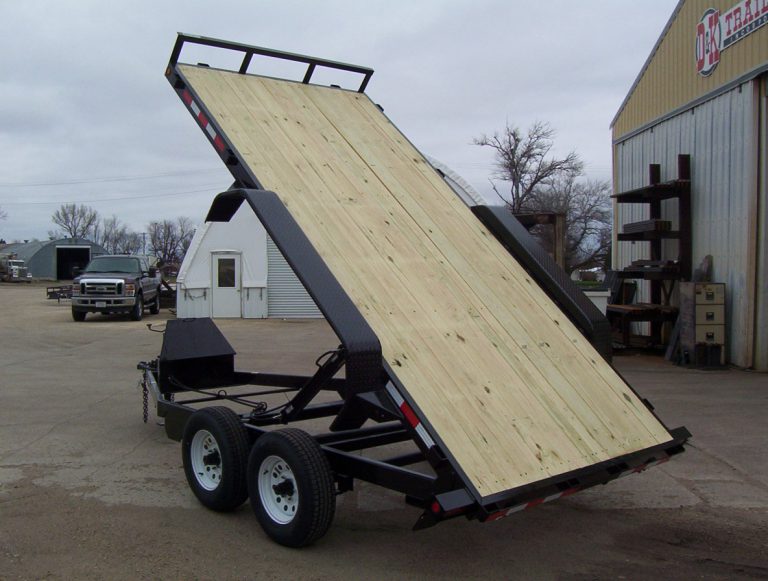
These are somewhat close. We wanted a dump trailer, but we don’t have room for two separate trailers, and we need the features of the low flatbed car hauler type trailer.
Also, we didn’t want the heavy weight of the steel side-walls.
So, D & K Trailers has agreed to make a “dumping car hauler” trailer for us. The pictures below are of a similar trailer that they have made before.
Our trailer will have a steel floor rather than the wood floor shown in the photos.
We will also have drop torsion axles to keep the deck as low as possible.
My John Deere 1025R and I recently had the opportunity to help my friend Brian fix/improve a drainage problem in front of his tractor/trailer storage shed. Perfect problem for the 260 Backhoe!
There is a link below to watch the highlights of the project. This posts explains the project in a bit more detail, as often our videos bring as many questions as answers. So, enjoy the video, and then read on (below the video link here) to see some more details.
Location and Setting
Brian’s property is located in/near Jolietville. Not sure it is really a town, more of a ‘cross-roads’ so to speak. The most interesting business (to me, anyway) is the Urban Farmer store which is located there. Not sure if this is a second location, or if they are moving from 161st in Westfield. In any case, it might be worth checking out their site, as almost all of their business is online.
Back to Brian’s property. He has approximately 2 (very nice) acres there, easy access, shaded backyard, and tremendous soil in the back which makes a wonderful garden. Yea, you figured it out, I am a little jealous!
Weather
The aforementioned shade on the western side of the property came in handy for us. We arrived later in the evening after we had both put in full days at our ‘real jobs’ writing software and managing a software team. The day had been incredibly hot, but as the shade took over, it was actually quite pleasant to work, especially since I didn’t have to do much manual labor!
We had recently experienced large rains (2-3 inches). I’m sure these rains prompted Brian to ‘finally’ take action on the project. We’re all the same, right? Put it off as long as we can!
The Backhoe Project
Brian would experience flooding/ponding in front of his tractor/trailer shed when big rains came. So, he decided to install a drainage channel next to the concrete slab which would provide a professional looking surface while giving the water a place to escape. He chose to get this plastic drainage channel from Menard’s. It wasn’t cheap, but it looks very professional when completed.
Additionally, he had some corrugated tile on hand which we were able to attach to the end of the drainage channel. We routed this tile away from the building to a location with suitable slope allowing the water to flow freely.
The iamge below shows where we ended the corrugated pipe run. we ran it ‘through’ the wall, where it finally saw enough fall for the pipe to resurface without going uphill.
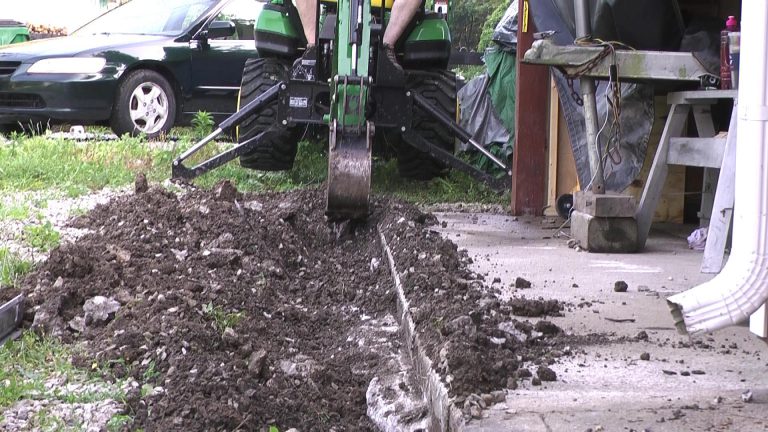
Notice the confined space in which we were working. Perfect problem for the 1025R. To use a larger backhoe, like a Case 580, would have required moving a bunch of junk (er…stuff) out of the way, but the 1025R was able to slide right in there no problem.
The Surprise Challenge
Digging 6″ depth or so with the 260 Backhoe for a 30 ft. length is a nearly trivial project. However, we almost always encounter a surprise. In this case, we encountered concrete which had leaked out under the bottom edge of the form when it was originally set.
This photo shows the situation fairly well.
The video (above) clearly shows that the 260 Backhoe was not up to the task of breaking this concrete. This is likely a good thing, as I probably would have broken the slab if I had pulled much harder on these annoying hunks of exposed concrete.
We finally convinced Brian to bring out his air hammer (which he had been bragging about for 1/2 hour). By the time he finally brought it out, I wasn’t even sure it REALLY existed. I didn’t see the brand name. I suspect it was ‘Tool Shop’, as Brian mentioned it came from Menards. I didn’t find a ‘Tool Shop’ brand on their website, but this one should be close Menard’s Air Hammer
The air hammer made light work of the situation. By the time Brian finished with that, I was finished with the rest of the trench.
Hanna helped us put the drainage tile in, and we were able to declare victory.
Another project “made easy” (and fun) by the John Deere 1025R TLB.
I hope you enjoyed it.
Don’t forget to save money while showing your support for Tractor Time with Tim. Buy John Deere parts @ GreenFarmParts. Use coupon code TTWT for a significant discount.
One of the most frequent topics in the Tractor Time with Tim comment section is whether I need a tractor given my small yard space.
This is very easily and simply answered. No! I don’t need a tractor at all. I could accomplish most of our yard work tasks with a Deere 100 series or 300 series lawn mower. Better yet, any of the myriad brands of ZTR mowers would to the job nicely.
I was effectively handling snow removal with my walk behind blower. I was able to till the garden by borrowing neighbor Bob’s tiller, and with enough arm twisting, I was even able to get Christy and Katriel to help me dig a 100+ foot trench 2-3 ft deep to run a drainage tile.
While I certainly didn’t need a tractor, now that we’ve had one, it is hard to see how we ever did without it. That trench I spoke of, well, it nearly killed us, or at least that is what we thought at the time. When the next trench digging project came along, it was a joy to dig, with Katriel and I almost fighting to get our hands on ‘the shovel’. Of course the shovel had a seat, made lots of noise, and dug with much less effort than my old tile spade!
We have used the Artillian Forks on more occasions than I can count, including delivering the new washer and dryer from the truck bed to the door, hauling tree limbs and brush, even helping to dig out a small tree.
For me personally, even more important than the completed projects is the distraction from the day to day stresses of a ‘desk job’. As shown in my tail light replacement video, even a ‘mistake’ on the tractor can provide stress relief after a difficult day at the office.
Another positive result of the tractor is that we finally have a way to be more ‘helpful’ to our neighbors. I’ve long known that the best way to have good neighbors is to BE a good neighbor. The tractor provides a way that I can help the neighbors tackle projects that they might otherwise not do at all, or might pay someone a large sum of money to do. The relationships we are building are incredible.
So, do I need a tractor? Now that I think about it, yes, I DO need a tractor!
Today I had the chance to attach a 5 foot box blade to Johnny (our John Deere 1025R).
There is a crushed stone parking lot behind our church which needed some work. Since I’ve been considering purchasing a box blade for Johnny due to the various projects we’ve been encountering, one of the church members suggest I try out the church’s to evaluate whether I could use it.
This particular blade is a Land Pride BB1560. It has 4 scarifiers. According to the Land Pride specifications, it weighs 428 pounds. I don’t know that any of my observations would be specific to this particular box blade. Rather, I believe they would apply generally to any brand of blade.
The Process
When facing a driveway or parking lot with potholes, one might first think that simply filling the potholes with rock would be the best solution. However, this doesn’t work very well in practice. Typically cars will quickly push the rock right back out, re-opening the pothole again.
Instead, the driveway or parking lot needs to be ‘dug up’ somewhat with the dust/dirt/rock becoming all mixed together, and the potholes being destroyed by this digging.
After the area has been dug-up, then one begins the process of leveling out the mixture of dirt/rock.
It is all about weight
I found that I could not get the scarifiers to dig in to the hard-packed parking lot without additional weight. Even though 428 pounds seems like a lot, it was not enough to penetrate the packed rocks.
I added 8 of my 42lb Deere suitcase weights. This really helped. However, even weighing approximately 800 lbs was still hardly enough to penetrate.
Lots of trips
The initial trip over the packed rocks rarely had much impact. The scarifiers would penetrate only 1/2 inch or so. However, by the 3rd trip over, I was getting sufficient penetration for the blade to begin to dig in. Once the blade began to pull downward, I was usually able to break through the hardest packed rock.
How Deep to run the scarifiers during initial digging phase??
I’m not sure I figured out the optimal depth for the scarifiers. I know that they needed to be below the cutting edge of the blade. For awhile, I had them several inches below the blade, thinking that I wanted to cut deep, so the scarifiers should be deep.
Then, later, as I mentioned above, I noticed that when the blade began to dig-in and the box began to fill up, the scarifiers would penetrate more effectively.
So, in this particular situation, having the scarifiers about 1 inch below the blade cutting height seemed to work best.
Would LESS scarifiers be better?
When shopping for a box blade, I had noticed that different blades of the same size might have a different number of scarifiers. I’ve seen from 3 to 5 on the 4-5′ blades. For some reason I had assumed that more scarifiers would be better. More is always better, right? After using this blade today, having difficulty getting it to dig in, I’m not as convinced that more is better. If I had concentrated that 800 lbs of downforce on less scarifiers, perhaps they would have been forced to dig in.
Difficult to create level surface
I found that it was difficult to do finish work with the blade on the 1025R. I believe this can be attributed to some basic ‘weaknesses’ of this size tractor.
The short wheel-base exaggerates the up and down movement on the blade. So, as I would hit humps and valleys, I found it difficult to smooth these out
Similarly, the narrow width of the tractor contributes to the same exaggeration of movement. Longer wheelbase, and wider stance would minimize this movement.
The 3 point hydraulics don’t seem to respond as gracefully as say the front end loader hydraulics. Maybe I would get better at this with practice, but I found it hard to make small adjustments (successfully) with the 3 point hitch. Perhaps this is closely related to the two bullet points above.
it is behind me instead of in front of me. I like working with the loader because I don’t have to twist my neck all of the time. I find it difficult to closely monitor a rear-mounted implement.
So, when it got to the detailed finish, I would recommend using the loader to ‘back-drag’. This works beautifully.
What is the best size blade for the 1025R
I’ve heard folks debate between the 4 ft and 5 ft sized box blades for the 1-series. I found that I could not pull a box full of rock while the scarifiers were digging with this 5 ft blade. I could not get sufficient traction even with the loader, wheel weights, filled tires, and all of my cheeseburger-enhanced ballast.
Having said that, I really like having a few inches beyond the size of the rear tires. With the wheel weights, 48 inches does not quite extend beyond the edge of the tires.
So, if I get serious about buying a box-blade, I believe I will look at a 54″ width. Not all companies make them, so I may be forced to reconsider, but I have seen several.
As for other features , as mentioned above, I am not going to dismiss a blade with 3 scarifiers now.
Also, I would like to find a blade with a suitable place to hang my 42lb weights. I will certainly want them for additional down-force.
I’ve had lots of questions recently about the lift options for the 1-series mid mount mowers. This is understandable, as the choices ARE confusing. So, let’s discuss the different lift options, how they work, and why you might choose one option over another.
Mechanical Mower Lift
First, let’s remove one point of confusion. The “Mechanical Mower Lift” is not, well, mechanical! When I think of mechanical, I think of the old craftsman riding mower with the big lever sticking up in the way of your knee so that it rams into your leg upon every bump.
No, the Mechanical Mower Lift is fully hydraulic and requires no ‘muscle-power’ to lift.
I wonder how many hydraulic lifts are sold simply because of this mis-understanding? If my dealer hadn’t taken the time to fully explain this, I would have almost certainly ended up with one of the other options.
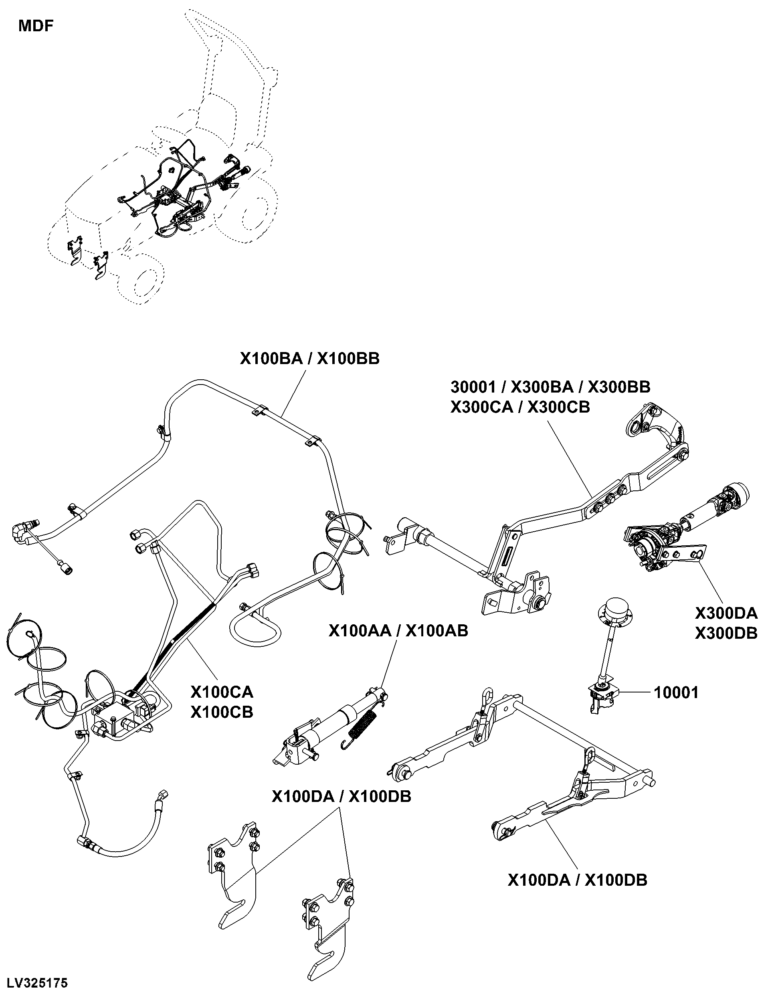
The mechanical lift is controlled by the 3 point hitch mechanism. There is a mechanical connection between the 3 point hitch ‘rock-shaft’ and the mower lift mechanism. This is where the name ‘mechanical’ comes from.
This lift option is the simplest of the three approaches. There are no hydraulic lines for the operator to deal with. The lift mechanism is out of sight and out of mind.
One advantage of this mechanism with the 1025R is that the operator can accurately control the height of the lawn mower while operating. For instance, let’s say you have a ridge in your yard which typically causes the mower to scalp. With the mechanical lift, you can raise the 3 point hitch lever slightly so that the mower will mow accurately over that ridge without scalping. You can use the numbers by the 3 point hitch lever to provide a consistent guide to the mower height. Of course, for normal mowing, you should lower the deck so that the height is controlled by the mower height control knob, but it is nice to know that you can adjust accurately to unique situations in your lawn.
This option is the least expensive, and can be upgraded to either of the other options at any time if the operator decides that the mechanical lift is insufficient.
The disadvantage of the mechanical lift is that the 3 point hitch and mower lift cannot be operated independently. While mowing, the 3 pt arms will be lowered.
You CAN lock the mower in its ‘up’ position and lower the 3 point arms without lowering the mower. So the limitation only exists while the mower is lowered (in-use).
So, ask yourself if you plan to use the 3 point hitch while operating the mower. I don’t know of a good reason to do so unless it would be a bagging attachment. Otherwise, I would recommend removing the mower deck before using any 3 point attachment.
You can see a good example of the 3 point positioning during mowing in this video
To upgrade to the independent hydraulic lift, these parts are needed:
BLV10739 and BLV10688
If you have the power beyond kit, it is slightly more complicated. Refer to this document for more details.
You can get these parts at GreenPartStore, and you’ll get a free shipping if you use coupon code “TTWT” at checkout.
Hydraulic Mower Lift
The two ‘hydraulic’ lift options use the loader SCV (Selective Control Valves) to control the lift rather than the 3 point hitch mechanism.
This option uses one of the SCV ports which are typically used by the loader, snow blower, broom, or blade. If attaching to one of these other implements, you will need to disconnect this hose, before proceeding to attach the other implement.
The net result is that this option provides independence from the 3 point hitch, but introduces a conflict between the mower and any front mounted attachment.
This option provides some control of the height of the deck, but it doesn’t provide the precision which the 3 point hitch lever can provide.
It also adds approximately $350 to the cost.
Overall, in my opinion, this is the least attractive of the 3 options.
To upgrade the hydraulic lift to the independent hydraulic lift, order:
BLV10688
Independent Hydraulic Mower Lift
For control of the mower deck fully independently from 3 point hitch attachments and front mounted SCV (Selective Control Valve) connected attachments, one needs to choose the Independent Hydraulic Lift.
The lift mechanism is the same as the hydraulic lift. This option adds the necessary plumbing and valves to allow independent control of the deck and front attachments at the same time. It also adds a new ‘rocker switch’ near the operator’s left knee for raising and lowering the deck. This rocker switch does not provide the precise control of the mechanical option, nor does provide the hydraulic feel of the SCV loader control used in the hydraulic mower lift.
This option just shy of $900 (if starting from ‘mechanical lift’).
Summary
After I understood that the mechanical lift was not actually mechanical, it was obvious to me that this was the option for me. It was the most simplistic approach, the most cost effective approach, and it provided the most control of the deck.
I’d be interested in hearing your opinion in the comments section.
When I first began to catch ‘tractor fever’ for real, I was attracted to the Deere x700 series. I felt that it would be big enough to use for fun, yet small enough that I MIGHT be able to justify it to Christy. Looking solely online at specifications, other users comments and opinions, seemed to confirm my thinking. The all-wheel steer models were attractive to me for mowing, and until this point, I figured mowing would be 95% of my seat time.
I DID want to consider a loader. There were a few videos of the Deere 45 loader in action on the 700 series. Specifically one showing the x739 with all wheel steer. I soon learned that the 45 loader had been discontinued, dampening this thinking somewhat. However, I found an aftermarket loader for the x700 series, so I wasn’t totally out of options in this area.
I also dreamed of having a rear mounted tiller. Again, a youtube video reinforced the possibilities on this. Clearly the x700 series had enough horsepower to run the 4 ft tillers. It would also lift the tiller high enough to get it out of the ground, but just barely.
At this time, I hadn’t even considered the 1-Series. Obviously it was more tractor than I needed, so I didn’t even give it a thought.
One visit to the local JD dealer changed all of that for me. When I saw the 700 series and the 1-series side by side. I began to realize that perhaps I COULD use the 1-series, even on my small property. The physical size was not nearly as intimidating as I had expected.
On a whim, Christy and I stopped at another JD dealer and drove a 1025R around the parking lot. We were specifically interested in the turning radius. A specification doesn’t really help one to get a feel for the turning radius. Christy drove around in a circle two or three times, backed up, moved forward, moved forward only an inch or so (to determine how easy it was to control), then hopped off and said “I can mow with that”.
What a wife!
I share this story because it is the same story I have heard over and over from other 1-series owners. They went to the dealership to buy a large lawn mower, and eventually came home with a 1-series.