We’ve already found some interesting uses of our dump trailer. When considering buying something like this, one usually thinks of soil, rock, etc. However, many other scenarios can benefit from a dumping trailer.
Just like the front end loader, or backhoe on a tractor, the hoist on a trailer provides a useful general purpose tool which helps with all kinds of projects.
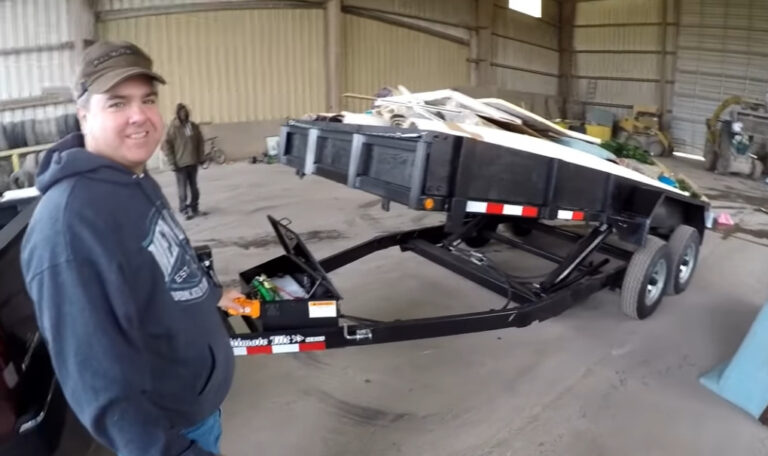
In this video, you’ll see how we were able to use the dump trailer to avoid unloading a bunch of heavy carpet rolls and other junk from the trailer.
Growing up on a farm, my dad has always had a Ford F350 with a dump bed on it. We have used the dump bed for countless tasks. Now, living in the city, I can’t justify a dump truck, and it would be too tall for Johnny to dump on anyway, so a dump trailer seems like the best compromise.
Dump Trailers are not cheap, licensing is not cheap either, and my storage space is limited. So, for me, I needed to combine all of my trailer needs into a single trailer. This is the reason for the custom built “dumping car-hauler”.
I think I will be very happy with this trailer. Of course, I’ve already found things I would do differently, but that is simply part of learning.
If you are interested in such a trailer, contact Brad at D&K Trailers He can help you out.
Announced back in August, the new 2017 Deere ‘large chassis’ 2-series (2032r/2038r) tractors are arriving in dealerships as you read this.
In this article, we will look into some of the new features these tractors have to offer.
If you are impatient, and don’t want to read all the way to the end, the changes can be summarized fairly simply. These tractors are:
Larger overall. (Heavier, Longer, Wider)
Easier ‘attachability’ (is that a word??)
More comfortable
..and yes, a bit more expensive.
Within the 2-series tractors, there are two frame sizes. The 2025r is the ‘small chassis’ model. The 2032r and the new 2038r are tagged as the ‘large chassis’ 2-series tractors. The larger chassis tractors got this redesign first, and the small frame 2025r redesign is slated to be completed sometime this year.
Edit: We recently caught up with Jared, the Product Manager responsible for the new 2-Series tractors (and all of the other compact utility and small utility tractors). If you haven’t seen our interview, I would suggest you watch it as part of your research
The 2038r is an entirely new tractor in the 2-series lineup. With 37.3 HP, it is the largest tractor we’ve seen in this series. Having said that, other than engine/pto horsepower, the 2038r and 2032r appear to be identical.
Watching the new 2032r/2038r Deere marketing videos, one quickly sees the focus on increasing the overall stability of these tractors. The wheelbase is 4% (~2.5 inches) longer, 17% wider, and 23+% heavier.
The additional length will make the tractor ride better at the expense of a larger turning radius. 2.5 inches might not sound like much, but it increases the turning radius by almost 2 feet!
The additional width should make a meaning difference in side to side stability. As a 1-series owner, it is easy to see the disadvantages of a narrow tractor. Of course, we will need wider attachments to cover the wheel tracks. For instance, a 5 ft bush hog or tiller might not cover the entire width of the tractor.
I’m excited about the additional weight of the tractor. 2436lb vs. the older version’s 1973lbs. The additional weight will be noticed in several ways. 1) Increased stability 2) better ride with less ‘bouncing’ 3) Better handling of ground engaging attachments like plows, disks, blades, etc, and 4) better handling of the FEL. I’m guessing any existing 2-series owner-operator will be able to detect this improvement within a few minutes of operation. The tractor will simply ‘feel stronger’.
Improved Attachability
The ease and flexibility of attachments has improved dramatically in this update. Let’s start at the front of the tractor. The ‘quick attach’ system for front implements like blades, brooms, and snow-blowers system has served Deere lawn and garden tractors well for many years, it just isn’t strong enough for tractors as large as the 2-series. So, Deere has upgraded the 2032r and 2038r to use the category 1N front 3pt hitch currently used in the 3R tractors. Not only does this provide a stronger more reliable connection, it also provides compatibility with these larger 3R compatible attachments like the 59″ snow blower and the 66″ front blade.
Moving to the center of the tractor, the 2-series finally gets Deere’s famous ‘auto-connect’ deck. I LOVE the auto-connect on my 1-series, and from the look of this new setup, it appears to be both stronger, and easier to connect/disconnect than the system on the 1-series. If you were staying away from the 2-series because of no ‘auto-connect’, you no longer have an excuse.
At the rear of the tractor, the new 270B backhoe is much improved over the older 46 (used by the prior 2032r). The top link of the 3 point needs to be removed (easy enough), then just back into the hoe, and pick it up. Connect the power beyond and you are ready to go.
If you’d like to do a little mowing while you have the backhoe attached, no problem. The mower can be attached at the same time.
While some might scoff and say “I would never want to mow with the loader or backhoe attached”, I beg to differ. I wouldn’t want to start in on a 5 acre yard hauling FEL and backhoe, but sometimes one needs to mow a small area and doesn’t want to dismount any other attachments. With these new tractors, you have the flexibility if you need it.
Comfort
There are several changes aimed at improving operator comfort. The seat is much improved. It sits lower (again for better stability). The controls are more easily accessible.
The e-Throttle feature will make managing the engine speed easier by integrating it with the hydro-static foot pedals.
The fuel tank has been moved to the left rear fender, making it much easier to fill the tank with 5 gal cans. Of course, I would recommend anyone using this large of a tractor to find another fuel storage solution. I use a 55 gal drum. Check it out here.
Summary
The new 2032r and 2038r are much more capable than their predecessors. If you are interested in a new 1,2, or 3 series, these new tractors will certainly affect your decision process. Do they make the decision easier or harder? They certainly provide another option.
We’ll continue to look at these new tractors over the next few weeks. I plan to provide in-depth comparisons to the 1-series and 3-series hopefully providing more input to your decision process.
Perhaps you’ve had the opportunity to watch the first video about our visit to Levi’s house. That video shows Levi’s beautiful property and a little about him, but there is so much more than appears on the screen.
Levi has a wonderful wife, Lucy, who was just as wonderful as Levi is. She welcomed us into her home and made us feel like her house was our house. She was open and friendly, and I could’ve talked to her for hours!
I soon learned that Lucy has a wonderful garden – including lots of vegetables and even fruits like blackberries, blueberries and black raspberries. Her basement is filled with jars of jellies, tomatoes, and pickles that she’s canned. One thing on their shelves I didn’t recognize; Chowchow, which is a southern dish with green tomatoes, onions, and bell peppers (for those of us who didn’t grow up in the south). She sent us home with a jar of black raspberry jelly and a jar of chowchow, so we’ll try it soon!
Although I could tell she didn’t feel great, Lucy was more than willing to show us the garden and the barn. The garden was a very steep walk up the hill in their backyard, but even in the winter it was evident that warmer weather will bring beautiful plants and large harvests. I could see Lucy and Levi’s love for gardening from the effort they put into keeping up such a big garden. Now, I really want to add some blackberry bushes to our garden! We’ll see what dad thinks about that.
It was a rather chilly day, and before long all of our noses were bright red and we were ready to head inside. Before we got in the door, one of Lucy’s grand-kids said, “I want peanut butter and ice cream!” Little did I know that I was about to experience a truly life-changing dessert. Originating from a boredom of vanilla and chocolate pudding, one day Lucy decided to add peanut butter to pudding instead. It was an instant hit. With the days of making pudding behind her, now she adds peanut butter to vanilla ice cream. The ratio is simple: one spoonful of peanut butter for one bowlful of ice cream. Then she stirs it until it’s smooth and incorporated completely. The resulting slurry is one of the best desserts I’ve ever had. 10/10, would eat again.
That was only the beginning! She had made a peach cobbler, which my mom says was delicious. Upon hearing that I couldn’t eat anything with wheat in it, she scurried off to another room and returned with an entire plate full of chocolate covered peanut butter balls and whatchamacallit bars and fudge. Oh my goodness, they were good. I may not have gained the freshman 15 from Purdue, but if I had spent much more time with Lucy, I know I would have.
Of course, the best part about Lucy was her stories. She grew up in a family with 22 kids, and has 65+ grandkids and great-grandkids. Even though I only got to talk to her for a few hours, by the time I had to leave, I really felt like she was my friend.
Lucy and Levi, along with the other people I’ve met through Tractor Time with Tim, continue to prove that farmers, both full-time and hobby, are down-to-earth people. Every YouTube comment, every GTT post, and every interaction we have with the tractor community brings us joy – both in your positive words and the knowledge that we’ve found a network of fun, enjoyable people to be friends with. I can’t wait for more opportunities to meet more of you and make even more friends!
The holidays are rapidly approaching, and perhaps you’re looking forward to spending some quality time with your tractor during your time off. I know my dad is! However, Christmas Break will also be here for us kids. Sometimes playing with tractors can be a solo activity, or maybe your teenage daughter just isn’t interested in all that machinery stuff.
I vouch, from experience, that spending time with my dad while working with Johnny has been an incredibly positive experience. I’ve learned about the mechanics of the tractor, how to operate the backhoe, tiller, loader, and other implements, and best of all, I’ve gotten to spend a lot of quality time with my dad doing something that he loves.
So, here’s some of my ideas to get your kids off the couch and onto the tractor seat.
If you live in a snowy area, your tractor is practically begging you to go play in the snow! In previous years, my dad has used his snow blade to clear our driveway and also a lot of our neighbors. If you have elderly or disabled neighbors, clearing their driveway can be an excellent way to show them some love during the winter. If you have little kids, bundle them up, and have them sit on your lap and “steer” while you help out your neighborhood! You, the responsible adult, still have full control of the tractor, but your little one gets to drive, play in the snow, and help their neighbors all at the same time. I tried to get my dad to let me do this, but he said I was too big. Hmm.
If you’ve never had a white Christmas, maybe you could consider starting a garden. About three years ago, I asked my dad if we could start a garden, and it has been nothing but joy for our entire family. We used Johnny to till up an area of our yard for the garden, and we use Johnny to hill potatoes and chop up left over corn stalks among other things.
Check out some of our older YouTube videos to see almost all of the projects Johnny helped us out with in the garden. I love gardening because after tilling and planting your favorite veggies, essentially you just watch them grow until they’re ready! Gardening can be an excellent learning experience as well. For most of us, food comes straight out of the grocery store, and it’s so cool to see your food come straight out of the ground. I’ve learned how to take care of several different types of vegetables and crops, and now I’m studying Molecular Biology to genetically improve those crops! Plus, if you grow more than you can eat, your local food pantry would love to have fresh produce. Or, you can fill your loader with potatoes and drive around the neighborhood offering them to your neighbors, as my dad and I have been known to do.
If you still have leaves on the ground, your kids might enjoy getting to drive around the yard and help mulch the leaves! When I was younger, before we had Johnny, my dad used to let me drive over the leaves with our lawn mover. I was 9 or 10, and far too young to drive a vehicle, but driving the lawn mower in the backyard was both legal and helpful, not to mention fun! In fact, I would have loved to driven over the leaves in our YouTube video demonstrating our leafy mulchy thing, but dad thought it was so fun that he wanted to do it himself.
Again, if your kiddo is too small to reach the pedals, you can always sit them on your lap so they can steer! (Dad’s edit: Just don’t tell the safety police)
I can’t say enough good things about all the times I’ve spent with my dad and Johnny. Besides being educational, they’re some of my fondest memories. Perhaps this Christmas, you can add some quality Tractor Time with *insert your name here* to your kid’s stack of presents.
Here is a list of interesting and useful gifts for your tractor-holic.
If you haven’t seen the associated video, take a look at it here for the introduction:
Here is the list of items discussed in the video.
Deere Deluxe Spinner Knob
First up is the nicest looking spinner knob I’ve ever seen.
Spinner knobs are not common on automobiles, although they were sometimes used many years ago with manual steering. In those cases, it took many turns of the wheel to make a tight turn. Now, refined power steering optimizes the steering to make it work smoothly and simply.
The 1023e/1025r power steering works well too. However, a spinner is useful in many scenarios where quick turning is required. For instance, mowing around obstacles requires lots of quick turning to be efficient.
Some folks don’t find the spinner useful, and perhaps even find it to be in the way. Having grown up with them on every tractor we had, I find it hard to do without one.
I used to recommend a “prettier” knob. However, over time, these have proven to be difficult to install, as well as to keep attached. While this knob is not quite as attractive, it WORKS. It installs on any steering wheel that I have tried, and it has been reliable for the long term.
Be sure to add code TTWT when placing your order to receive free shipping. You can use this code for ALL purchase at GreenPartStore.com, providing a very nice discount.
Why didn’t Deere include a pedal on the differential lock rod from the factory? Many folks smarter than me have asked this question. Presumably, they left it off purely for cost savings.
Differential Lock Pedal
In any case, while not a requirement, this is a nice enhancement to your 1023E, 1026R, or 1025R.
This item is $40 plus shipping. You can purchase it from Ken’s Bolt On Hooks
Heavy Duty Seat Springs
“Every time I hit a bump, the seat bottoms out, jarring my back!”
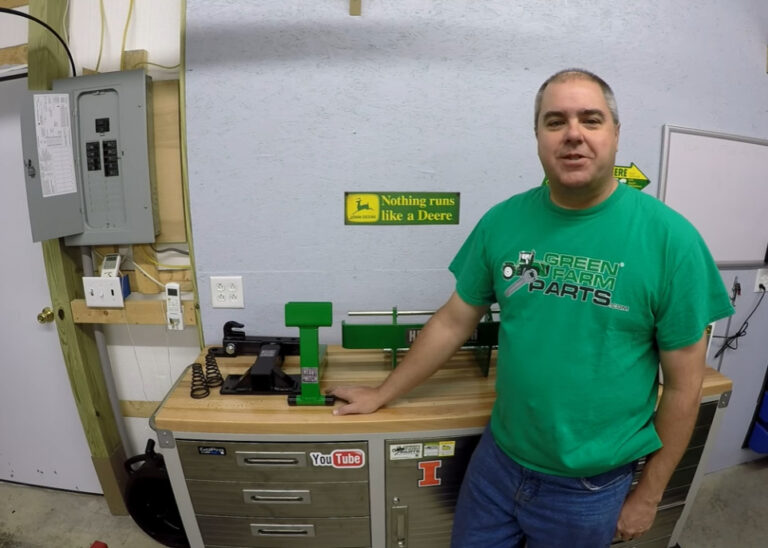
Many of us are having the same experience. Thankfully, there is a remedy. These upgraded seat springs (now zinc plated) are only $30 for a set (2 springs).
Installation is easy, as detailed here:
Receiver Hitch Drawbar
Another feature nearly forgotten on the 1-series is the drawbar. The flat plate with a hole in it is much more like a garden tractor than a real tractor. The heavy hitch 2-inch receiver hitch drawbar plate fixes this. Not only can you attach a drawbar, but you can also use any other 2-inch receiver compatible hitch. For instance, you can use a trailer hitch ball for hooking to a trailer.
If you already have a Heavy Hitch, you are probably thinking that you will hook your trailer to it. While this is fine for short distance moving, it presents problems in some situations. The 3-point hitch is not ‘fixed’ vertically. It can go up at any time without notice. So, if your trailer becomes back-heavy, putting an upward force on the tongue, the 3 point hitch will go upward, potentially dumping your load, or worse.
Imagine this situation if you are hauling your grand-kids on a hay ride. All of the sudden, the trailer tongue raises unexpectedly. This could spoil the fun immediately.
The Heavy Hitch receiver plate solves that problem, as well as several other annoying issues when pulling trailers or other small implements.
Ok, Christy just laughs at me for this one. Admittedly in our small yard it is overkill. However, if you have a long driveway, dragging the trash can back and forth can be an annoyance, and if really full, it can be tiring.
Enter the ‘Hitch-N-Can’.
This little device changes an annoying chore into “tractor time”.
Less that $47 with the TTWT coupon code.
Oh, and they now have a ‘dual adapter’ so you can haul two at once. Now I’m jealous. I’ll have to get one of those!
The value of the Heavy Hitch is its versatility. Unlike the uni-tasker ballast box, the heavy hitch supports many functions. One key component of this versatility is the removable 42lb (or 70lb) weights.
Why not make this system even more versatile by allowing those weights to be used on the front of the tractor?
If you have the quick hitch installed, this is difficult because the QH bracket is in the way of the standard John Deere front weight bracket.
The Heavy Hitch front weight bracket turns that challenge into a feature, using the quick hitch as its mounting point. So, this bracket can be easily attached or removed as needed. You can use the same 42lb (or 70lb) weights you already have.
One more item for your consideration. I love my Heavy Hitch (as if you haven’t already figured that out). However, I haven’t talked much about the storage cart I got along with it. Without this cart, I’m not sure I would be as pleased with the purchase. The cart makes the solution much more flexible. The Heavy Hitch is easier to attach/detach because of the cart. It is more portable and easier to store because of the cart.
The price seemed high at first, but now that I have it, I would not be without it.
Face it, the tractor lover in your life doesn’t want a Tie. He doesn’t want any of that stuff advertised on TV. He wants new gadgets for his tractor. While this list is incomplete, hopefully it can provide a starting point for your Christmas shopping.
Finally getting around to posting some information about our new trailer. Of course, you may have already seen our brief overview video. If not, it is linked below. I’ll provide some more photos and discussion of the features here.
While that video does a pretty good job of showing the overview, some details might be missed. Let’s start at the front.
This photo shows the upgraded coupler. This coupler and hitch assembly is rated for 12,000 lbs. It is height adjustable, and has an easier way to lock/unlock the ball than less expensive hitches.
Behind the hitch, you see the break-away system complete with a battery. If the trailer ever becomes unhooked from the truck while on the road, the brakes will lock up, keeping the trailer from running me over, or running over anyone else.
Moving back a bit further, you’ll see the ‘big momma’ jack. Brad (@ DK Trailers) discussed many upgrade options as I was configuring the trailer. He mentioned that a heavy duty jack was available. In my mind, I was thinking the standard jack was one of those wimpy jacks which in practicality won’t hold up a 50lb bag. So, I was quick to jump on the ‘upgraded jack’.
Now that I know Brad’s ways better, I should have realized that his ‘standard’ jack would be equivalent to everyone else’s upgraded jack. I’m certain that the jack he installed on this trailer would lift a freight train!
While it functionally works well, it isn’t very handy for my situation. It cranks too slowly, it is too heavy, and in general, is simply too large for my trailer.
This, of course, is my fault, because I insisted on the upgraded jack! Oh well.
Also in the above photo, you see the steel box which contains the fluid reservoir, hydraulic pump, battery, and electrical components necessary for the dump feature. Not visible from this side, but protruding from the other side, is the male 120v connector which can be used to recharge the battery. This is a typical ‘battery tender’ type of device which provides a low amperage charge to the battery. The battery is also charged via the truck when the 7-pin tail light connector is connected.
Moving to the rear of the trailer, this close-up photo shows the latch which keeps the ramps from sliding out on their own. If you look closely below the latch, you can see the roller I asked Brad to add. This roller makes it much easier to remove/insert the ramps from/to their storage racks.
Here, Brad is demonstrating how easy it is to pull the ramp out. One handed! The easiest way is to ‘push down’ a bit while pulling it out. This forces the main weight onto the roller rather than the channel ‘slides’ further into the trailer.
Dump Feature
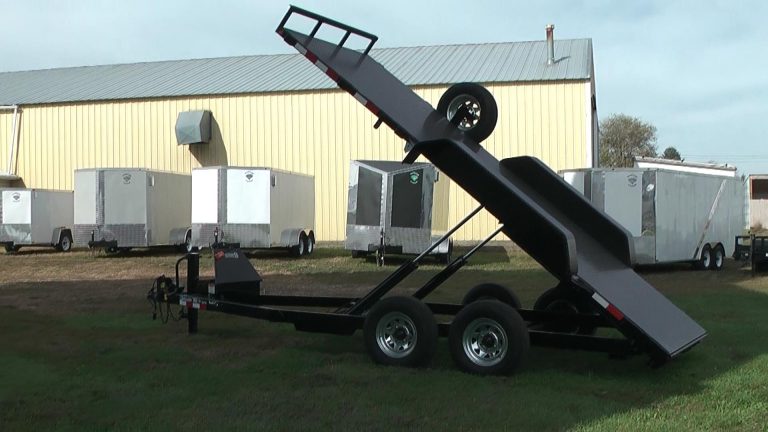
It wouldn’t be right to avoid mentioning the dump feature in this post. Afterall, this is the main reason I chose this trailer. This photo shows the trailer in its ‘fully tilted’ position. Approximately 45 degrees. Hopefully this will be sufficient to get material to slide out.
Here is a view from under the trailer. There are two 3 1/2 x 36 inch cylinders. Together, they are rated to lift 10,000 lbs. This should be more than sufficient for this 10,000lb gvwr trailer. I suppose it would be possible to put a large load at the front of the trailer. This would cause strain on the cylinders. However, this situation is not likely anyway, as the tongue weight would be too high if loaded on the front. So, we’ll simply have to make sure we load it over the axles.
Not easy to see in this photo, but I wanted to point out the safety pole laying down just to the right of the right-most cylinder. This can be stood up and wedged against the bed so that one can safely work under the deck while it is raised.
I’ll post more information in the future as I use the trailer further. Until then, be sure to check out the D&K Trailers website to see examples of other custom trailers Brad and his team can build for you.
After spending your grand-kid’s inheritance on your new sub-compact tractor, it makes sense to consider how you can use it for snow removal.
The question is, do you need any more attachments/accessories to remove snow efficiently and successfully?
There are a surprising number of snow-removal options for the 1-series. We’ll evaluate the most popular configurations here.
Front End Loader
One might call this the ‘default’ option. If your 1-series came with a loader, this option might not cost you any extra. For many of us, that is very important. We’ve spent more than we should have on our new toy/tool than we should have anyway.
The loader can move snow, but frankly, by itself, it isn’t very efficient. One advantage is that one can pile snow quite high. So, deep snow can be removed with the loader. However, it is difficult to keep from digging into your gravel driveway, or scratching your asphalt or concrete driveway.
If you are considering this option, I would recommend looking into a set of Edge Tamers. Be sure to use coupon code TTWT at checkout for a 5% discount.
Edge Tamers reduce the bucket’s tendency to dig into the driveway surface. This is an inexpensive solution, allowing your bucket to become an effective snow removal tool. With the Edge Tamers, your bucket becomes somewhat like a ‘snow pusher’ mentioned below, but at much less cost.
The Edge Tamers should work well in southern climates where snow is less frequent, and often falls on ‘un-frozen’ ground. This scenario makes it very difficult for some of the other solutions below to work well. However, the Edge Tamers should allow your bucket to float right over the unfrozen driveway.
Another use for the Edge Tamers is to ‘get by’ until you can afford one of the more expensive solutions below. Spend a few dollars now to get through the first winter or two, then as funds become available, and you have more experience with your tractor, invest in one of the more expensive solutions below.
This is the same 54 inch blade used on the x700 Signature Series, as well as the older 400 and 500 series tractors. The complete solution including quick hitch and raise/angle cylinders will cost you $1300-$1500 new.
The parts required for this solution are a bit confusing. Rather than attempting to list the exact parts required for your tractor, I’ll refer you to the Mutton Power 54 Blade Configuration Tool.
Advantages
Fast Cleanup (faster than loader or blower)
Easy to attach/detach, and switch to loader or mower deck.
Quiet, smooth operation when equipped with rubber cutting edge
Compact size, and power angle makes snow removal easy in tight situations
Disadvantages
Blade doesn’t lift very high, so hard to push large piles of snow. (see proposed solution below)
Not quite wide enough for the 1-series when fully angled (see proposed solution below)
Doesn’t handle extremely deep snow-falls well. I have plowed 10 inches without any issues. As of yet, I do not know the ‘maximum’ the blade would take. However, the blade certainly won’t handle as much as the blower or loader.
Quick Hitch mechanism is cumbersome, and slightly under-engineered for the 1-series, and even more so for the 2-series.
Before moving to the next option, I should mention a few options available for this solution which might make it more attractive for you
Artillian Upgrades (rubber cutting edge, and wings)
Artillian offers a couple of enhancements which improve the performance of the 54 blade. The wings provide another 6 inches or so on each end of the blade. This makes the blade approximately 66 inches wide. This is plenty wide for the 1-series, even when fully angled. Additionally, the rubber wings are much safer when operating near a house or car.
The rubber cutting edge allows the blade to slide quietly, and clean the surface completely.
These kits come with all of the necessary hardware to mount to your blade. Once you get these options, you can use rubber ‘horse stall mats’ for replacements as necessary.
A picture (or video) is worth a thousand words. Take a look at my “Artillian enhanced” 54 blade in action here:
Loader mounted 54 blade
Enhance the 54 Blade solution with the Artillian Quick Hitch Adapter.
This solution provides most of the advantages of the 54 blade with a few additional advantages. You can pile snow as high as necessary, and you can quickly remove the blade for loader operations.
Advantages
Most of the advantages of the 54 blade alone
Ability to ‘Pile it high and deep’
Easy removal to use loader for other things
Disadvantages
Higher cost than 54 blade alone (but still cheaper than snow blower)
Less ‘compact’ than 54 blade alone
Here is the Artillian view on snow management options:
47 or 54 Snow Blower
The front mounted snow blower is the premier solution for high snow-fall areas. If you count your snow-falls in feet instead of inches, then you should definitely consider the front mounted blower.
Folks often ask whether they should buy the 47 or 54 inch version. The 1-series tractor is about 47 1/2 inches wide. This might work when going perfectly straight. However, when turning or maneuvering for a corner, it is much easier to have a blower wider than the tractor. I have never heard any complaints about sufficient engine power for the 54 inch, so I would highly recommend choosing it.
While this is a wonderful choice for high snow fall areas, there are some significant disadvantages to this solution. Let’s evaluate the advantages and disadvantages closely.
Advantages
Ability to remove large amounts of snow
Throws snow long distances. This prevents large piles right beside the driveway
With appropriate cutting edge, cleans the driveway very nicely
Disadvantages
High initial cost
Can throw rocks at your windows
Unpleasant to drive without a cab. (Snow blows back in your face).
Doesn’t work well with small snowfall (1-2 inches)
Slower to use for smaller snowfalls (less than 10 inches)
More difficult to remove than other options. Must remove mower auto-connect to install PTO shaft. There is no ‘auto-connect’ for the snow-blower.
Like the 54 Blade, the front mounted blower uses the Quick Hitch connection to the tractor. It also requires an additional component to connect the mid-PTO to the blower. Again, I’ll refer you to Mutton’s excellent snow blower page rather than attempting to list the exact parts necessary for your tractor.
If you choose to get a snow blower, I would recommend that you consider a cab for your tractor. I’m planning a post on some of the enclosure options for the 1-series.
Snow Pusher
Another option is a ‘snow pusher’. CT Attachments makes a snow pusher compatible with the Deere loader quick attach (JDQA) system.
A snow pusher is similar to your loader bucket. The most notable difference is that it has no ‘bottom’. It is used to push large piles of snow rather than pick up a bucket full of material. The ends are larger and deeper than a regular bucket which keeps the snow contained in front of the pusher rather than it ‘leaking’ around the edges. This approach makes it easier to do the final cleaning on a surface.
The CT Attachments example above is a 72″ pusher. This is likely a bit too wide for the 1-series, but perfect for the 2-3 series.
Advantages
Easiest system to attach/detach
Easier to use and less driveway damage than front end loader bucket.
No custom hydraulics necessary. Uses built in loader hydraulics
Maybe less flexibility in snow placement? If in a small driveway, this might be an issue
Might have difficulty pushing large piles of snow on slick driveway with 1-series
Overall, this seems like an attractive option due to its simplicity and utility. I do not have personal experience using one so I cannot comment further. (Hint to CT Attachments 🙂 )
Frontier rear snowblower
Another option is a 3-Point Hitch attached snow blower. Used in combination with the front end loader, this solution provides multiple weapons to ‘attack’ old man winter.
Advantages
Easy connect/disconnect (with I-Match, or even better, with I-Match auto-hitch).
Can handle any snow situation.
Could be combined with snow pusher for even more utility
Disadvantages
My neck hurts. I’m tired of looking backwards
Nearly as expensive as front mounted blower
Personally, this is one of my least favorite options. I just don’t want to ‘go backwards’ all of the time. However, in the right situation, I could see that it would provide the most flexible options for snow removal.
Summary
The 1023E/1025R can be a tremendous snow removal tool. There are many viable configurations. Some of the configurations can be used as stepping stones from a financial standpoint. For instance, you could purchase the 54 blade and quick hitch now. If that proves to be insufficient to handle your snowfall, you could add the Artillian loader mount quick attach adapter. There is very little cost duplication in that scenario.
Alternatively, you could add the front mount snow blower on the same quick attach frame you purchased for the blade. Again, the blade becomes a stepping stone.
If there simply is no budget available, I would suggest looking at the edge tamers. This will allow the loader to work as a competent snow removal tool without destroying your driveway. This option is less than $100 if you use the coupon code TTWT at checkout.
Oh, and there is one last option. Pray for spring to come soon!
Ok, so you’ve got your new compact or sub-compact tractor with front-end loader. Of course, the first thing you want to do is find something to dig up, right? Maybe you want to dig out a stump, dig a ‘watering hole’ for deer, who knows. …and frankly, who cares! I get it, you just want to DIG with your tractor!
Unfortunately, after the first few minutes, you realize that your tractor just isn’t big enough or strong enough to dig like you want it to dig. The bucket doesn’t seem to want to penetrate the hard soil, and the wheels slip, or the engine doesn’t have sufficient power to force the bucket into that hard-packed earth.
Thinking about it, this makes perfect sense. A 49″ (or 53″ or wider) bucket attempting to penetrate across its entire width at the same instant requires lots of force. It would be much easier if we had just a few small ‘points’ on the bucket which would penetrate first, then as we continue to push, the soil would be broken loose. This is exactly the concept behind the Heavy Hitch toothbar.
There are 14 small points (7 teeth each with 2 points) … 6 teeth on the 49″ model. Each of these teeth is about 1/4″ wide. It is much easier for the tractor to force this small surface area into the hard-packed earth than a full 53″.
This video illustrates the point. This crushed stone driveway had been in place for many years, and was packed very tightly. I now wish I had tried it without the toothbar just for the experimentation, but honestly, I don’t think I could have penetrated it. Before getting the toothbar, I had planned to use the backhoe to break it loose.
So, you can see that it will dig. As they say in infomercials, “But wait, there’s more…”. In addition to digging, I had some projects where I needed to clear out some vine-y brush. This was actually the very first time I had used the toothbar. As you’ll hear in this video, we were all amazed at how it just reached right in there and grabbed the brush.
Katriel aptly named it “Tractor Steroids”. It really does make the tractor seem stronger.
At first, I figured a toothbar was much ado about nothing. Another fancy add-on which would not help the tractor at all. My experience with it has been just the opposite. Because of the small size/weight of the tractor, digging without the toothbar seems futile. This should be ‘standard equipment’ on all (sub)compact tractor/loaders.
You can get the toothbar at Heavy Hitch Toothbar. Be sure to use coupon code TTWT for a 5% discount on your entire purchase. This discount applies to ALL heavy hitch products.
The John Deere 1025R seems to be designed for feather-weight drivers. Unfortunately, I’ve never seen a cheeseburger I could pass by, so my built-in organic ballast makes the seat bottom-out on the smallest of bumps.
Given the small diameter tires, short wheelbase, and narrow width, the 1-series doesn’t handle bumps very well, so a seat which bottoms out easily makes it even worse.
The problem is the weak springs used to hold up the seat. In 2014 (or so)…apparently AFTER my tractor was built… Deere increased the strength of the springs slightly, but from all reports, still not enough to be comfortable for a 225lb+ driver. Ken’s springs are rated for 260lbs. (130lbs each).
Update: Ken recently improved the springs by “Zinc Plating” them. This removes the need to paint.
These springs fit only the 1025R. The 1023e seat is made differently, using rubber bumpers under the rear of the seat.
Installation of the springs is a fun simple project. Katriel and I put together a video showing how to install them. Notice that the installation is easy, and can be fun.
If you are more disciplined at the table than me, then the spring upgrade may not be useful at all for you. However, If you are “cheeseburger challenged” like me, you will find Ken’s Seat Springs to be an inexpensive fix to a painful problem.
You can order a set of springs directly from Ken’s Bolt On Hooks.
As soon as you get a utility tractor you realize that many projects which were difficult before are now easy, and projects which were totally impossible before are now even enjoyable.
Then, you realize that a few accessories and modifications would make your tractor even more useful. Questions you might be having:
I know that some accessories would help, but I’m not sure exactly what I need?
Where can I get accessories which are specifically designed and sized for my tractor?
Can I install the necessary accessories myself, or do I have to pay an expert to do it?
Over the next few articles, we’ll evaluate some of Ken’s most popular products, showing how they can be used to make your tractor tasks easier.
Of course, the first product we need to consider is the “Bolt On Hook”. This is the product which got it all started for Ken.
While the Bucket on the front-end loader is quite versatile, there are certain situations for which it is not perfectly suited. For instance, it is hard to pick up something which won’t sit in the bucket.
For these situations, farmers have welded hooks to their loader buckets for many years. They will purchase a hook much like these: Ken’s Weld On Hooks
Then, they simply weld them directly to the bucket.
For most sub-compact utility tractor owners, this is not feasible for a couple of reasons. First, we are not typically equipped with the tools or skills to do the welding. Second, the buckets on our loaders are too thin/weak to handle a direct-welded hook.
Ken’s bolt on hook products solve both of these issues. The hooks require only a drill and 1/2 inch metal cutting bit to install. This might still be somewhat intimidating to new tractor owners, but it is a relatively easy process.
Additionally, Ken’s hook has a built in plate on the hook side, and a couple of options for ‘backing plates’ which solve the strength issue of these light weight buckets.
Ken provides an excellent video showing how to install the hooks…
The hooks open up many new possibilities for using your loader bucket. You can carry large objects, either IN the bucket, or hanging from the bucket.
This is by far the biggest bang for the buck you can add to your front end loader. For less than $100 including shipping, you add much more flexibility to your loader. Once you get the hooks, you’ll find yourself using them to solve even challenges on your property, and make even more projects “fun”.
So, I would recommend that you make the Bolt On Hooks one of your first accessory purchases for your new compact utility tractor.